CATTI-题库-真题-模拟-课程-直播
 国新办
国新办
 2026-06-18

 203次
203次
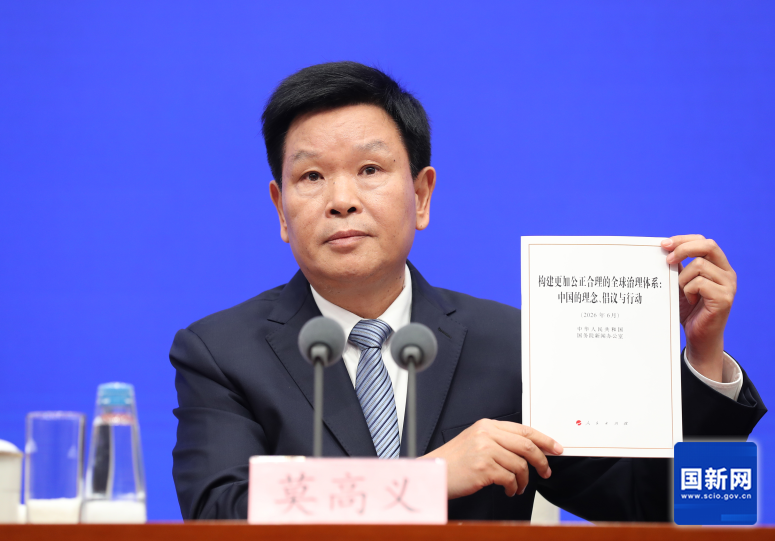
构建更加公正合理的全球治理体系:中国的理念、倡议与行动
More Just and Equitable Global Governance: China's Principles, Proposals and Actions
(2026年6月)
June 2026
中华人民共和国国务院新闻办公室
The State Council Information Office of the People's Republic of China
目录
Contents
前言
一、当今世界面临严峻复杂的危机挑战
I. The World Today Faces Severe and Complex Challenges
二、全球治理倡议为破解难题提供时代答案
II. The Global Governance Initiative Responds to Challenges of Our Times
三、推进全球治理事业的中国贡献
III. China's Contribution to Promoting Global Governance
四、引领变革方向,迈向光明前景
IV. Guiding the Direction of Change Towards a Bright Future
五、在历史演进的重大关头携手前行
V. Moving Forward Hand in Hand at a Critical Juncture in History
结束语
前言
Preface
全球治理是关乎人类福祉的共同事业,构建公正合理的全球治理体系是各国人民孜孜以求的共同愿景。
Global governance is a common endeavor that bears on the wellbeing of all humanity, and building a just and equitable global governance system is a shared vision long pursued by people from across the world.
80多年前,联合国的创立为各国对话协商处理国际事务搭建了多边合作平台,确立了国际法治规则,开创了全球治理的崭新实践。冷战结束后,世界多极化、经济全球化进程加速,以协调合作为基石的全球治理理念日益深入人心。但一段时间以来,单边主义、保护主义、霸权主义肆意横行,和平赤字、发展赤字、安全赤字、信任赤字持续扩大,如何改革完善全球治理、破解难题挑战,切实发挥联合国的核心作用,成为攸关人类前途命运的重大问题。
Over 80 years ago, the United Nations (UN) was founded as a multilateral platform for countries to address international affairs through dialogue and consultation. It established international rules underpinning the rule of law, ushering in a new phase in global governance. After the Cold War, multipolarization and economic globalization began to gain momentum, and the concept of global governance grounded in coordination and cooperation was widely endorsed. In recent times, however, unilateralism, protectionism, and hegemonism have been spreading unchecked, while deficits in peace, development, security, and trust continue to expand. Reforming and improving global governance to resolve these challenges and letting the UN play a core role have thus become a critical topic for the future of humanity.
中国始终是全球治理的积极参与者、贡献者和建设者。新时代以来,习近平主席历史性提出构建人类命运共同体重大理念,倡导共商共建共享的全球治理观,主张践行真正的多边主义,推动平等有序的世界多极化、普惠包容的经济全球化。2025年,在世界反法西斯战争胜利和联合国成立80周年的关键历史节点,习近平主席郑重提出全球治理倡议,为解答“构建什么样的全球治理体系、如何改革完善全球治理”的时代命题提供了中国方案。
China has always been an active participant in, contributor to, and builder of global governance. In the new era, President Xi Jinping put forward the vision of building a community with a shared future for humanity. In promoting a global governance system characterized by extensive consultation and joint contribution for shared benefit, he has called for true multilateralism to foster an equal and orderly multipolar world and a universally beneficial and inclusive economic globalization. In 2025, at a pivotal historical juncture marking the 80th anniversary of the victory in the Global War Against Fascism and the founding of the UN, President Xi proposed a new initiative, the Global Governance Initiative (GGI).
全球治理倡议一经提出,迅速得到近160个国家和国际组织支持响应,60多个国家踊跃加入“全球治理之友小组”。国际社会认为,全球治理倡议发出了高举多边主义旗帜、汇聚团结力量、追求公平未来的明确信号,顺应了国际关系民主化的时代潮流,提振了国际社会践行多边主义的坚定信心,给出了完善全球治理清晰可行的路径方案,为动荡不安的世界注入宝贵的稳定性和正能量。
The GGI is designed to offer a Chinese solution to the two pressing questions of the era: what kind of global governance system should be established, and how global governance can be reformed and improved. Upon its introduction, it swiftly gained support from nearly 160 countries and international organizations, with over 60 countries joining the Group of Friends of Global Governance. The international community believes that the GGI sends a clear signal: uphold multilateralism, unite forces, and pursue a fair future. The GGI aligns with the growing trend towards greater democracy in international relations and bolsters international confidence in practicing multilateralism. It offers a clear and feasible roadmap for improving global governance, bringing valuable stability and positive energy to a turbulent world.
中国提出全球治理倡议,旨在推动构建更加公正合理的全球治理体系。落实全球治理倡议,最根本的是坚定维护联合国的权威和地位,最关键的是大国展现责任担当,最需要的是各国团结合作,最紧迫的是弥补和平与发展赤字。必须毫不动摇地维护以联合国为核心的国际体系,维护以国际法为基础的国际秩序,维护以联合国宪章宗旨和原则为基础的国际关系基本准则,而不是另起炉灶。
China has proposed the GGI to expedite the building of a more just and equitable global governance system. Resolutely upholding the UN's authority and status is fundamental to the effective implementation of this initiative. Success will also hinge on major countries bearing a sense of responsibility, and on all nations uniting and cooperating to address deficits in peace and development. All countries should firmly uphold the international system with the UN at its core, safeguard the international order based on international law, and uphold the basic norms governing international relations underpinned by the purposes and principles of the UN Charter, instead of reinventing the wheel.
为介绍中国关于全球治理的理念、倡议和行动,更广泛凝聚国际社会共识,更有效应对全球性挑战,构建更加公正合理的全球治理体系,中国政府特发布本白皮书。
The Chinese government is publishing this white paper to introduce China's principles, proposals and actions in global governance, foster broader consensus within the international community, ensure more effective responses to global challenges, and build a more just and equitable global governance system.
一、当今世界面临严峻复杂的危机挑战
I. The World Today Faces Severe and Complex Challenges
我们生活的时代正经历百年未有之大变局,人类和平与发展事业任重道远。二战后建立起来的国际体系受到多重危机的严重冲击,全球治理处在不进则退的关键当口,世界比以往任何时候都更需要重振多边主义,更需要坚守规则法治,更需要提升治理效能。
Our world has entered an era marked by profound change on a scale unseen in a century. The pursuit of peace and development remains a daunting challenge. The international system established after World War II has been severely disrupted by multiple crises, placing global governance at a critical crossroads. Progress is imperative; failure to advance risks falling behind. Now, more than ever, the world needs to revitalize multilateralism, uphold the rule of law, and ensure more efficient governance.
(一)日益严峻的挑战呼唤更加有效的治理
1. Growing Challenges Call for More Effective Governance
当前,国际形势变的深度史所罕见、乱的烈度更加突出,国际政治经济纷争加剧,很多矛盾掀开盖子,各种“黑天鹅”“灰犀牛”层出不穷,人类文明的航船驶入遍布暗礁和风暴的危险水域。
Currently, the international landscape is undergoing profound changes on an unprecedented scale, with turmoil and upheaval more intense and pronounced. Political and economic disputes worldwide are escalating, revealing deep-seated conflicts, while "black swan" and "grey rhino" events keep emerging continually. The ship of human civilization has entered dangerous waters with hidden reefs and violent storms.
地缘矛盾日趋激化,武装冲突多点爆发。乌克兰危机进入第5个年头,中东战事外溢扩大,多个热点问题延宕难解。全球和平指数持续恶化,2025年武装冲突数量创二战结束以来新高,50多个国家直接卷入冲突战乱。全球军费开支急剧扩大,军国主义沉渣泛起,核扩散、“核共享”敲响警钟,国际安全处于脆弱时刻。
Geopolitical tensions are intensifying, with armed conflicts erupting in multiple regions. The Ukraine crisis has entered its fifth year, hostilities in the Middle East are spilling over and spreading, and multiple hotspot issues remain unresolved. The Global Peace Index continues to decline: in 2025, the number of armed conflicts reached a new high after World War II, with more than 50 countries directly embroiled in conflict or war. Global military spending has surged, militarism has resurfaced, and nuclear proliferation and "nuclear sharing" continue to pose a grave threat, leaving international security in a precarious state.
世界经济碎片化加剧,发展进程严重受阻。经济全球化遭遇逆流,筑墙设垒、“脱钩断链”、滥施关税扰乱世界经济运行。联合国2030年可持续发展议程落实严重滞后,近八成具体目标进展迟缓甚至出现倒退,全球超过8.3亿人处于极端贫困状态,23亿人处于粮食不安全状态,南北鸿沟、贫富分化持续拉大。
Global economic fragmentation is exacerbating, significantly hindering development. Economic globalization is facing strong headwinds, as some countries erect fences and barriers, pursue decoupling, sever industrial supply chains, and impose unilateral tariffs, disrupting the global economic order. Overall progress in the implementation of the UN 2030 Agenda for Sustainable Development has lagged far behind, with nearly 80 percent of assessable targets progressing slowly or even regressing. More than 830 million people worldwide still live in extreme poverty while 2.3 billion suffer from food insecurity, and the North-South divide and wealth gap continue to widen.
新型挑战接踵而至,多重危机交织叠加。气候转型面临困境,数字鸿沟持续扩大,人工智能滥用引发安全风险,粮食和能源安全挑战加剧,恐怖主义、网络攻击、跨国犯罪、生物安全等非传统安全威胁上升,人类社会需要共同面对的问题更加复杂多元。
New challenges are arising in quick succession, with multiple crises intertwining and accumulating. The transition to a climate-resilient future is fraught with difficulties, the digital divide is deepening, and the misuse of artificial intelligence poses new security risks. Challenges to food and energy security are also intensifying, and non-traditional security threats such as terrorism, cyberattacks, transnational crime, and biosecurity risks are on the rise. The issues that human society must collectively address are becoming increasingly complex and diverse.
宇宙只有一个地球,人类共有一个家园。各国不是各自乘坐在190多条小船上,而是共同乘坐在一条命运与共的大船上,唯有同舟共济、守望相助,才能穿越全球性挑战的风浪,驶向更加美好的未来。
The universe has only one Earth, which is the shared home of all humanity. Countries are not riding separately in some 190 small boats, but aboard a single giant ship of shared future. Only by working together and supporting one another can we navigate through the storms of global challenges and sail towards a brighter future.
(二)丛林法则严重冲击国际法治
2. The Law of the Jungle Seriously Undermines the International Rule of Law
在两次世界大战废墟上建立起来的联合国大厦为人类和平与发展遮风挡雨,联合国宪章奠定了全球治理的制度基石。历史只能前进而不能倒退,血与火的教训必须深刻汲取,丛林法则的重演必须全力避免。
Built upon the ruins of the two world wars, the UN serves as a shelter for peace and development, and its Charter laid the institutional cornerstone for global governance. History can only move forward, not backward; we must draw lessons from the bloodshed and fires of war of the past and prevent a return to the law of the jungle at all costs.
单边主义、霸权主义危害深重,公然践踏国际法和国际关系基本准则。个别国家以大欺小、恃强凌弱,对主权国家悍然动用武力;搞本国优先、双重标准,出于一己之私挑战国际公义;拼凑各种小集团、小圈子,在21世纪重演挑动分裂对抗、划分势力范围的旧剧本,成为当今世界最大乱源。
Unilateralism and hegemonism cause only grave harm, openly trampling upon international law and the basic norms governing international relations. By bullying the small and weak and brazenly wielding force against sovereign states, certain countries have shown they prioritize their national interests above all else, applying double standards and challenging international justice for their own selfish gain. These nations gang up to form exclusive groups and blocs, inciting division and confrontation and carving spheres of influence today – in the 21st century – as they did in centuries gone by. By so doing they have become the major source of global turbulence.
逆全球化、保护主义抬头,经贸问题政治化、工具化、武器化。有的国家挑起贸易战、科技战,滥施非法单边制裁和“长臂管辖”,执意打造“小院高墙”“平行体系”,泛化国家安全概念、对别国经济科技发展进行打压遏制,一系列倒行逆施违反市场经济原则,践踏自由贸易规则,严重破坏国际经贸秩序。
De-globalization and protectionism are on the rise, while economic and trade issues are being politicized, instrumentalized, and weaponized. Some countries have instigated trade wars and tech wars, imposed unilateral sanctions illegally, and abused long-arm jurisdiction. They have single-mindedly sought to build "small yards with high walls" or "parallel systems", and have overstretched the concept of national security to suppress and contain the economic and technological progress of other countries. These retrogressive actions violate the principles of the market economy, trample on the rules of free trade, and severely disrupt the international economic order.
站在历史的十字路口,公道正义还是弱肉强食,开放共赢还是隔绝对抗,国际法治还是强权政治,人类必须作出负责任的正确选择。
Humanity now faces several crucial questions. Fairness and justice, or the law of the jungle? Openness and mutual benefit, or isolation and confrontation? The rule of law, or power politics? At this historical crossroads, we must be responsible and make the right choice.
(三)弥补治理体系短板势在必行
3. It Is Imperative to Shore Up the Governance System
联合国是最具普遍性、代表性、权威性的国际机构,以联合国为核心的国际体系在全球治理中发挥着无可替代的重要作用。但随着时代发展和格局演变,现行全球治理体系不适应、不匹配的地方越来越多,短板赤字日益加剧:
The UN is the most comprehensive, representative and authoritative international organization, and the UN-centered international system plays an irreplaceable and vital role in global governance. Over time, however, the current global governance system has become increasingly incompatible and misaligned with the realities of today and the evolving international landscape, and its shortcomings and deficiencies are growing ever more pronounced.
权威性受到挑战。个别大国无视联合国宪章宗旨和原则,动辄退群毁约、撤资断供,阻挠安理会决议通过,瘫痪世界贸易组织争端解决机制,严重冲击国际秩序,多边机制运转困难增大,多边合作信任根基受到侵蚀。
The UN's authority is challenged. Disregarding the purposes and principles of the UN Charter, a certain major power has withdrawn from international organizations and agreements, defunded key bodies, blocked Security Council resolutions, and paralyzed the World Trade Organization's (WTO) dispute settlement mechanism. These actions have seriously disrupted the international order and caused further damage to multilateral mechanisms, eroding the foundation of trust in multilateral cooperation.
有效性亟待提升。一些国家拒不履行自身责任义务,多边议程议而不决、决而不行情况长期存在。联合国等多边机构运行效率、应急反应能力和工作透明度有待提高。人工智能、网络空间、外空等新兴领域治理缺位。
The effectiveness of multilateral institutions is in urgent need of improvement. As some countries refuse to fulfill their responsibilities and obligations, multilateral agendas are often left discussed but undecided, or decided but not implemented. Efforts must therefore focus on improving the operational efficiency, emergency response capabilities, and transparency of multilateral institutions such as the UN. At the same time, the existence of governance gaps in emerging fields – including artificial intelligence, cyberspace, and outer space – also demands attention.
代表性严重不足。有的国家为维护自身霸权和私利,长期阻碍联合国及其机构改革进程,致使国际货币基金组织份额、世界银行股权等改革严重滞后,广大发展中国家的代表性和发言权得不到充分体现。
The UN's representation is critically inadequate. To maintain their hegemony and protect their own interests, some countries have long obstructed the reform process of the UN and its agencies, causing significant delays in reforms such as the IMF quota and World Bank shareholding. Developing countries remain underrepresented and their voices insufficiently heard.
现行治理体系虽不完美,但不必推倒重来,也不需另起炉灶。要与时俱进改革完善,解决不匹配不适应的问题,以发展的姿态补齐治理短板,以进步的理念回应时代呼声。
The current governance system is certainly not perfect, but it needs neither to be dismantled and rebuilt in full, nor replaced entirely by a new system. Instead, as an international community, we must focus on reforming and improving the existing system to make it more compatible and aligned with the world's realities, addressing governance shortcomings from a developmental perspective, and responding to the call of the times with a vision for progress.
(四)全球南方声音需要更多倾听
4. More Global South Voices Need to Be Heard
作为求和平、谋发展、促合作的重要力量,全球南方群体性崛起是人类的进步。要让世界稳下来、好起来,需要在国际事务中更多回应南方诉求,充分发挥南方作用。
The Global South is a vital force in seeking peace, pursuing development, and promoting cooperation, and its collective rise represents human progress. To stabilize and improve the world, the international community needs to be more responsive to the concerns of the Global South in international affairs and fully leverage its role.
全球南方卓然壮大。二战后,亚非拉民族独立解放运动风起云涌,世界殖民体系土崩瓦解,联合国会员国从创立之初的51个增加到现在的193个。今天,按购买力平价计算,全球南方在世界经济中的比重超过60%,对世界经济增长贡献率达到80%,多个发展中心在各地区形成。少数国家垄断国际事务难以为继,长期存在的历史不公必须得到纠正。
The Global South has grown remarkably strong. After World War II, national independence and liberation movements swept across Asia, Africa, and Latin America, dismantling the global colonial system. The number of UN member states has increased from 51 at its founding in 1945 to 193 today. Based on purchasing power parity, the Global South now makes up over 60 percent of the world economy and contributes 80 percent to global economic growth, with multiple hubs of development across various regions. The monopolization of international affairs by a small number of countries is no longer sustainable, and long-standing historical injustices must be redressed.
全球南方为全球治理带来新气象。金砖国家实现历史性扩员,上海合作组织成为幅员最广、人口最多的区域性国际组织,为全球治理体系建设和改革发挥积极推动作用。二十国集团成为全球经济治理的主要平台,新兴经济体占到成员总数一半以上。“77国集团和中国”弘扬公道正义,深化南南合作。全球南方国家主办一系列多边峰会,在全球治理中留下南方印记、作出南方贡献。
This rise has brought a new dynamic to global governance. BRICS has undergone a historic expansion, and the Shanghai Cooperation Organization (SCO) has become the largest regional intergovernmental organization in terms of territory and population. Together, they are playing a positive role in the development and reform of the global governance system. The G20 has become the premier platform for global economic governance, with emerging economies now accounting for more than half of its membership. Championing fairness and justice, the G77 and China have deepened South-South cooperation. Meanwhile, Global South countries have hosted a series of multilateral summits, contributing their share to global governance and leaving their imprint.
时代呼唤更具包容性、公平性、可持续性的全球治理模式。全球南方国家在国际事务中的发展权、话语权、决策权得到更大尊重的过程,也必将是全球治理体系更有活力、更有效力、更有希望的历史进程。
The times call for a model of global governance that is more inclusive, equitable, and sustainable. The process of securing greater respect for the Global South countries' rights to development, voice, and decision-making in international affairs will mark a historic journey towards a more dynamic, effective, and hopeful global governance system.
二、全球治理倡议为破解难题提供时代答案
II. The Global Governance Initiative Responds to Challenges of Our Times
全球治理倡议以维护联合国宪章宗旨和原则、践行共商共建共享的全球治理观为基本遵循,提出奉行主权平等、遵守国际法治、践行多边主义、倡导以人为本、注重行动导向五大核心理念,切中诸多危机挑战的症结和根源,为构建更加公正合理的全球治理体系提供科学指南。
The Global Governance Initiative upholds the purposes and principles of the UN Charter and embraces a global governance vision characterized by extensive consultation, joint contribution, and shared benefits. It is built on five core concepts: sovereign equality, the international rule of law, multilateralism, a people-centered approach, and real actions. By addressing the crux and root causes of crises and challenges, the initiative provides sound guidance for building a more just and equitable global governance system.
(一)奉行主权平等
1. Sovereign Equality
主权平等是联合国宪章开宗明义提出的基本原则,是规范国与国关系最重要的准则。各国体量有大小、国力有强弱、发展有先后,但都是国际社会平等一员,主权和尊严都必须得到尊重,都有权在全球治理进程中平等参与、平等决策、平等受益。
Sovereign equality is enshrined in the UN Charter as the first among all principles and the supreme norm regulating state-to-state relations. Countries, whether large or small, strong or weak, developed or developing, are equal members of the international community. Every nation's sovereignty and dignity must be respected, and all countries are equally entitled to participate in, deliberate on, and benefit from global governance.
国与国相处要把平等相待挺在前面。各国要本着相互尊重的态度平等协商,妥善管控矛盾分歧,大国应该有大国的样子,做讲平等、讲诚信、讲合作的表率,而不能从所谓“实力地位”出发,推行霸权霸道霸凌。背离了主权平等原则,国际关系将退化为强权博弈,国际法将失去逻辑起点,世界将永无宁日。
Equality is the premise of state-to-state relations. Countries should, in the spirit of mutual respect, conduct consultations on an equal footing and manage their differences appropriately. Major countries should lead by example in honoring equality, good faith, and cooperation, rather than leveraging their position of strength to engage in hegemonic, high-handed and abusive acts. If allowed to deviate from the principle of sovereign equality, international relations would degenerate into a game among powers, and international law would become groundless, leaving the world in perpetual chaos.
主权平等是团结应对挑战的必然要求。现在,共同利益、共同挑战、共同责任已经把各国的前途命运紧密地联系在一起。只有确保所有国家平等地参与治理,而不是少数几个发达国家垄断话语权,各方才能建立团结协作的基本政治信任,产生的规则和决策才具有广泛的认同感和坚实的合法性,才会形成“大家商量着办”的强大合力。
Sovereign equality is an essential requirement for solidarity against challenges. The future of all nations is bound by shared interests, common challenges, and collective responsibilities. Global governance cannot be dominated by a select few developed nations. Only when all countries participate equally can all sides build the political trust essential for solidarity and collaboration; only in this way can the resulting rules and decisions receive extensive recognition and rest on solid legal ground. This is the necessary approach to reaching broad consensus and creating powerful synergy.
讲平等讲包容是治理体系演进的历史大势。多元共生是人类社会本来的面貌,多极共存是国际格局发展的要求。提升全球治理体系代表性、包容性、普惠性是大势所趋,权利平等、机会平等、规则平等是人心所向,逆历史潮流搞强权霸凌那一套注定要失败。
Equality and inclusiveness are the inexorable progress in the evolution of the global governance system.Coexistence in diversity is a fundamental characteristic of human society, and multipolarity is vital to the evolving international landscape. A global governance system that is more representative, inclusive, and beneficial to all is an irreversible trend, and equal rights, equal opportunities, and equal rules are the shared aspirations of all peoples. Hegemony and power politics that run counter to the tide of history are destined to fail.
(二)遵守国际法治
2. The International Rule of Law
国际法治是全球治理的根本保障。唯有基于法治的全球治理体系,才能真正为各国提供公平公正的发展环境,确保权利与义务的平衡,推动国际秩序朝着更加公正合理的方向演进。
The international rule of law is the fundamental safeguard for global governance. Only a global governance system that is grounded in the rule of law can provide all countries with a fair and just environment for development, achieve a balance between rights and obligations, and make international order more just and equitable.
厉行国际法治,根基在于恪守联合国宪章宗旨和原则。当今世界发生种种对抗和不公,不是因为联合国宪章过时了,而是其未得到有效履行。联合国宪章明确了“维持国际和平及安全”“促成国际合作”“和平解决国际争端”“在国际关系上不得使用威胁或武力”等宗旨和原则,确立了国际关系的基本准则,构筑了战后国际秩序稳定的重要基石,必须毫不动摇加以维护。
Rigorously enforcing the international rule of law is rooted in upholding the purposes and principles of the UN Charter. Confrontation and injustice in today's world do not arise because the UN Charter is outdated, but because it is not effectively implemented. Its purposes and principles, such as maintaining international peace and security, promoting international cooperation, settling international disputes by peaceful means, and refraining from the threat or use of force in international relations, have established the fundamental norms governing international relations and underpinned post-war stability in the international order, and thus must be honored without the slightest compromise.
厉行国际法治,关键在于捍卫其公正性严肃性。只有确保国际法平等统一适用,而不是合则用、不合则弃,才能真正做到明辨是非曲直、促进和平与发展。各国都是国际法治的利益攸关方,如果没有了国际法治,昨天还在餐桌边,明天就有可能在菜单上。大国是促进国际法治的关键力量,尤其要带头守规矩、讲法治,不应将自身利益凌驾于国际法之上,更不应将自己的家法帮规强加于人。
Rigorously enforcing the international rule of law hinges on safeguarding its justice and integrity. Only when international law is applied equally and universally, rather than selectively, can we truly distinguish right from wrong and advance peace and development. All nations are stakeholders in the international rule of law – without it, anyone at the dining table today could appear on the menu tomorrow. Major countries are the key forces in advancing international rule of law. They should lead by example in following rules and upholding the rule of law, rather than putting their own interests above international law or, even worse, imposing their own rules upon others.
厉行国际法治,需要完善新兴领域规则制定。人类社会发展日新月异,全球治理的规则也需要跟上。深海、极地、外空、网络等新疆域,有的是人类共同财产,有的是未来发展前沿,规则空白、治理缺位的短板亟需补齐。应秉持和平、主权、普惠、共治原则,确保新疆域开发和利用有法可依,成为各方合作的增量,而不是相互博弈的战场。人工智能治理既要守住安全和伦理的底线,又要坚持开放共享、智能平权,确保智能向善,真正造福人类。
Rigorously enforcing the international rule of law calls for improving rulemaking in emerging sectors. Human society is constantly evolving, and global governance rules must keep pace. New domains such as the deep seas, polar regions, outer space, and cyberspace, some of which are the common property of humanity and some represent the frontiers of future development, require urgent attention in order to establish rules and close gaps in their governance. All parties should uphold the principles of peace, sovereignty, inclusiveness, and joint governance, and put law in place for the development and utilization of new domains, so that they expand the space for cooperation rather than become arenas of rivalry. The governance of artificial intelligence should guard the red line of security and ethics, and be pursued in the spirit of openness, shared outcomes, and equal rights, to ensure AI for good and truly benefit humanity.
(三)践行多边主义
3. Multilateralism
多边主义为和平与发展事业而生,多边机制对于解决全球性问题具有重要意义。没有哪个国家能置身全球治理体系之外实现发展,也没有哪个国家能脱离国际合作而赢得未来。多边主义不是一道选择题,而是唯一可行路径。
Multilateralism emerged for the cause of peace and development, and multilateral mechanisms are vital for addressing global issues. No country can achieve development outside the global governance system, nor can it secure a future without participating in international cooperation. It is not a matter of whether we choose it or not, multilateralism is the only viable path forward.
坚持共商共建共享。多边主义的要义是国际上的事由大家共同商量着办,世界命运由各国共同掌握。要以共商汇聚众智、以共建凝聚众力、以共享惠及众人,旗帜鲜明反对一切形式的单边主义,反对“一国独霸”、“几方共治”、集团政治。人为制造相互隔绝,只会把世界推向对立对抗的深渊。
Countries should stick to the principles of extensive consultation, joint contribution, and shared benefits. The essence of multilateralism lies in extensive consultation on international affairs and collective decision-making among all countries for the future of the world. Countries should pool wisdom through extensive consultation, gather strength through joint contribution, and promote universal interests through shared benefits. They should unequivocally oppose all forms of unilateralism, hegemony, dominance by a few countries, and bloc politics in the understanding that the deliberate erection of barriers will only push the world into the abyss of antagonism and confrontation.
坚决维护联合国核心地位。联合国是践行多边主义、推进全球治理最主要的平台。联合国的主导地位必须坚持、不容动摇,作用只能加强、不能削弱。各国要重温联合国创立的初心,推动联合国在新形势下重振权威和活力,发挥协调开展行动、共同应对挑战的中心作用。
Countries should be steadfast in safeguarding the central role of the United Nations. The United Nations is the primary platform for practicing multilateralism and advancing global governance. Its leading position must be upheld and remain rock solid; its role can only be reinforced, not weakened. All countries should reaffirm the founding purpose of the United Nations, work to restore its authority and vitality under new circumstances, and enable it to play a central role in coordinating global actions to address common challenges.
坚定促进多边对话协商合作。面对错综复杂的全球性挑战,任何一国都难以独善其身,难以单打独斗解决所有问题。要以对话聚共识,以协商化分歧,以合作促共赢,努力扩大各方共同利益的汇合点。发挥好各类全球和区域多边机制的建设性作用,调动各国政府、国际组织、非政府组织等多方资源和力量,推动全球治理更加协同高效。
Countries should be firm in promoting multilateral dialogue, consultation, and cooperation. In light of the complexity of global challenges, no country can remain insulated from their impacts or resolve all issues alone. Countries should build consensus through dialogue, resolve disputes through consultation, and pursue win-win results through cooperation, striving to expand their common interests. Global and regional multilateral mechanisms should play a constructive role in this, pooling the resources and strengths of national governments, international organizations, and non-governmental organizations to increase the synergy and efficiency of global governance.
(四)倡导以人为本
4. A People-Centered Approach
人类福祉是全球治理的核心关切,各国人民是全球治理的根本参与者和受益者。只有以人民的获得为目标,不断为民众提供信心和稳定预期,全球治理体系才能得到广泛支持并有效运作。
People's wellbeing is a core concern of global governance. The people of every country across the world are the essential participants and direct beneficiaries of global governance. Only by serving public interests, boosting public confidence, and meeting public expectations can the global governance system win extensive support and function effectively.
促进共同发展,为各国人民带来更大获得感。发展事关人民生活和尊严,这是一场希望和失望的较量。世界繁荣稳定不可能建立在贫富差距不断拉大的基础上,必须将发展重新置于国际议程的中心,动员全球发展资源,加快落实联合国2030年可持续发展议程。应尽快弥合南北鸿沟,帮助发展中国家增强自主发展能力,让发展成果更多更公平惠及各国人民。
Pursuing common development heightens the sense of gain among all peoples. Development concerns people's life and dignity; it is a matter of hope or disappointment. World prosperity and stability cannot be built upon ever widening gaps between rich and poor. Countries must restore development to the center of the international agenda, mobilizing global resources to implement the UN 2030 Agenda for Sustainable Development without delay. The North-South divide must be bridged as soon as possible, and help should be provided to developing countries to boost their capacity for independent development, so that all nations have greater and fairer access to the fruits of development.
应对共同挑战,为各国人民带来更大安全感。今天的世界,各国安危休戚与共。各方应该树立共同、综合、合作、可持续的安全观,统筹应对好传统安全和非传统安全威胁。面对气候变化、公共卫生、网络安全等各类风险挑战,应该让广大民众切实感受到,各国正在行动,团结可破万难。
Addressing common challenges heightens the sense of security among all peoples. In today's world, all countries share a common stake in security, and all must therefore embrace a vision of common, comprehensive, cooperative and sustainable security while addressing the threats to this stake – whether traditional or non-traditional. In responding to risks and challenges such as climate change, public health, and cyberspace security, it is important for the people to truly feel that countries are taking action and that unity can overcome all difficulties.
促进相知相亲,为各国人民带来更大幸福感。文明因交流而多彩,因互鉴而丰富。要以文明交流超越文明隔阂、文明互鉴超越文明冲突、文明包容超越文明优越,密切人文交流和人员往来,努力消除不同国家、不同群体间的思想隔阂,让维护共同利益成为共同信念,让不同文明交相辉映、相互成就。
Promoting mutual understanding and friendship heightens the sense of fulfillment among all peoples. Civilizations become colorful through exchanges and are enriched through mutual learning. Countries should let cultural exchanges prevail over estrangement, mutual learning over clashes, and inclusiveness over superiority. Cultural and personnel exchanges should be strengthened to break down ideological barriers between nations and social groups. A shared conviction for safeguarding common interests will allow all civilizations to thrive and succeed together.
(五)注重行动导向
5. Real Actions
全球治理的活力源于实践,关键在于行动,根本要看成效。美好愿景要靠实干来实现,国际社会要锚定共同目标,立足解决问题,采取一致行动。
Global governance finds its source of vitality in practice, hinges on action, and is verified by its effectiveness. A vision is realized only through concrete action. It falls on the international community to turn this vision into reality – setting common goals, embracing a problem-oriented approach, and acting in concert.
坚持整体推进与重点突破相结合。既要统筹推进全球治理各项议程,协同破解治理赤字,防止治理体系碎片化;也要聚焦各国尤其是广大发展中国家面临的突出问题,在减贫、民生、数字鸿沟等方面取得实实在在的治理成果和收获。
Coordinating overall progress and individual breakthroughs. A coordinated approach should be adopted to advance global governance agendas, address governance deficits, and prevent fragmentation in the governance system. Targeted efforts should also be made for the most pressing issues in individual countries, particularly developing countries, to achieve tangible progress in poverty reduction and in improving people's wellbeing and closing the digital divide.
坚持治标和治本相结合。立足当前,通过务实行动方案解决全球面临的紧迫问题,提升应对重大公共危机和提供国际公共产品的效能。着眼长远,探索沉疴痼疾根本解决之道,改善全球治理体系变革滞后的状况,使之符合变化了的世界政治经济。
Addressing both symptoms and root causes. Given present conditions, feasible plans should be made to resolve the immediate challenges facing the world. The effectiveness in responding to major public crises and providing international public goods should be increased. With future development in mind, fundamental solutions should be explored to tackle chronic and persistent issues and bring change to the global governance system – which is lagging in reform – to align it with the evolving political and economic landscapes.
坚持南北合作和南南合作相结合。南北双方要优势互补、相向而行,发达国家应切实履行国际义务,兑现发展援助和气候融资等承诺,不应以任何借口逃避国际责任。发展中国家应联合自强,完善南南合作机制,增强协同发展和集体发声能力,为完善全球治理注入不竭动力。
Synergizing North-South cooperation and South-South cooperation. The Global North and Global South should leverage their complementary strengths and move towards the same direction. Developed countries should diligently fulfill their international obligations and deliver on their commitments regarding development assistance and climate financing; they should not evade their international responsibilities under any pretext. Developing countries should unite to build their strength, improve South-South cooperation mechanisms, increase their capacity for collaborative development and their collective voice, and inject sustained momentum for improving global governance.
三、推进全球治理事业的中国贡献
III. China's Contribution to Promoting Global Governance
中国作为负责任大国,高举构建人类命运共同体旗帜,带头践行真正的多边主义,始终不渝做世界和平的建设者、全球发展的贡献者、国际秩序的维护者、公共产品的提供者,积极推动构建更加公正合理的全球治理体系。
As a responsible major country, China champions the building of a community with a shared future for humanity and takes the lead in practicing true multilateralism. It has consistently been a builder of world peace, a contributor to global development, a defender of the international order, and a provider of public goods, while actively advancing the efforts for building a more just and equitable global governance system.
(一)致力于普遍安全、共同安全
1. Committing to Universal and Common Security
人类是不可分割的安全共同体。作为在和平与安全问题上纪录最好的大国,中国把坚持走和平发展道路写入宪法,倡导共同、综合、合作、可持续的安全观,提出并践行全球安全倡议,为实现世界长治久安贡献力量。
Humanity forms an indivisible community of security. As a major country with the best peace and security record, China has enshrined in its Constitution a commitment to peaceful development. It champions the vision of common, comprehensive, cooperative, and sustainable security, and has put forward the Global Security Initiative and acted on its principles, contributing to lasting world peace and stability.
在联合国框架下坚定维护世界和平。中国忠实履行安理会常任理事国职责和使命,坚定支持联合国在国际事务中发挥核心作用,支持安理会在和平与安全问题上发挥首要作用。积极参与联合国维和行动,是联合国维和行动第二大出资国、安理会常任理事国第一大出兵国,迄已派出维和人员5万余人次,参加29项安理会授权的联合国维和行动,组建8000人规模的维和待命部队,率先组建全球首支成建制常备维和警队。2025年9月3日,中国作为第二次世界大战主要战胜国,隆重纪念中国人民抗日战争暨世界反法西斯战争胜利80周年,同国际社会一道捍卫二战胜利成果,弘扬正确二战史观,发出守护和平、正义必胜的时代强音。
Firmly safeguarding world peace within the framework of the UN. China faithfully fulfills its mission and duties as a permanent member of the UN Security Council, firmly supporting the UN in playing its core role in international affairs and the Security Council in playing its primary role in international peace and security. China also takes an active part in UN peacekeeping operations as the second largest contributor to the UN peacekeeping budget and the largest troop contributor among the permanent members of the UN Security Council. To date, more than 50,000 Chinese peacekeepers have been dispatched in 29 peacekeeping operations authorized by the UN Security Council. The country has also established the world's first standing peacekeeping police unit and maintains a peacekeeping standby force of 8,000 troops.
On September 3, 2025, China celebrated the 80th anniversary of its victory in the Chinese People's War of Resistance Against Japanese Aggression and the World Anti-Fascist War. Together with the international community, China will safeguard the victory of World War II, promote a correct understanding of that war, and send the powerful message that peace must be safeguarded and justice will prevail.
维护全球战略稳定。中国奉行防御性的国防政策,恪守不首先使用核武器政策,坚持自卫防御核战略,坚定维护国际核裁军和核不扩散体系。推动五核国领导人共同发表关于防止核战争与避免军备竞赛的联合声明,重申“核战争打不赢也打不得”理念,强调避免军事对抗、防止军备竞赛,发出了维护全球战略稳定、减少核冲突风险的共同声音。中国提出公正、合作、平衡、有效的军控理念,支持以联合国为核心的国际军控体系。
Maintaining global strategic stability. China pursues a national defense policy that is in nature defensive, upholds a firm commitment to a policy of no-first-use of nuclear weapons and a nuclear strategy of self-defense, and resolutely safeguards the international nuclear disarmament and nonproliferation regimes. It promoted the issuance of a joint statement of the leaders of the five nuclear-weapon states on preventing nuclear war and avoiding arms races, reiterating the view that a nuclear war cannot be won and must never be fought, emphasizing the need to avoid military confrontation and prevent arms races and articulating a shared commitment to maintaining global strategic stability and reducing the risk of nuclear conflicts. China has put forward the principles of justice, cooperation, balance and effectiveness in arms control, and upholds the international arms control regime with the UN at its core.
开创中国特色热点问题解决之道的成功实践。中国主张坚持不干涉内政、坚持政治解决、坚持客观公正、坚持标本兼治,提供了建设性解决热点问题的新选择。在乌克兰危机上,以“四个应该”为根本遵循,发布《关于政治解决乌克兰危机的中国立场》文件,会同巴西等全球南方国家发起乌克兰危机“和平之友”小组,为止战和谈汇聚合力、积累条件。在巴以问题上,推动安理会通过新一轮巴以冲突爆发后的首份加沙停火决议,向加沙提供紧急人道主义援助,旗帜鲜明支持“两国方案”,推动巴勒斯坦问题全面、公正、持久解决。促成沙特和伊朗历史性和解并复交,巴勒斯坦14个派别来华举行和解对话并签署《北京宣言》,中东“和解潮”深受欢迎。就维护和促进中东和平稳定提出坚持和平共处原则、坚持国家主权原则、坚持国际法治原则、坚持统筹发展和安全四点主张,同巴基斯坦共同发表关于恢复海湾和中东地区和平稳定的五点倡议。倡导安危与共、求同存异、对话协商的亚洲安全模式,促成缅北冲突相关方签署停火协议,就柬泰边境争端、阿巴冲突等发挥建设性作用。提出“非洲之角和平发展构想”,支持地区国家应对安全挑战。
Pioneering the use of a unique Chinese approach to addressing international flashpoints. China upholds the principles of non-interference in other countries' internal affairs, political settlement of issues, objectivity and fairness, and addressing both symptoms and root causes, offering a new approach for finding constructive solutions to flashpoints.
On the Ukraine crisis, China follows the four key principles1 as its fundamental guide. It released China's Position on the Political Settlement of the Ukraine Crisis and, together with Brazil and other Global South countries, launched the Group of Friends for Peace on the Ukraine crisis, building synergy and creating conditions for ceasefire and peace talks.
On the Palestinian-Israeli conflict, China has urged the UN Security Council to pass the first ceasefire resolution for Gaza since the outbreak of a new round of conflict. It has provided emergency humanitarian assistance to Gaza and taken a clear stand in support of the two-state solution, promoting a comprehensive, just, and lasting resolution of the Palestinian question.
China has facilitated the historic reconciliation and restoration of diplomatic relations between Saudi Arabia and Iran, and 14 Palestinian factions visited China for reconciliation talks and signed the Beijing Declaration on Ending Division and Strengthening Palestinian National Unity. This wave of reconciliation in the Middle East has been widely welcomed. In promoting peace and stability in the Middle East, China has put forward the principles of peaceful coexistence, national sovereignty, international rule of law, and a holistic approach to development and security. Together with Pakistan, China has issued a five-point initiative of China and Pakistan for restoring peace and stability in the Gulf and Middle East Region.
Championing an Asian security model characterized by security for all, common ground amid differences, and dialogue and consultation, China has facilitated a ceasefire agreement between conflicting parties in northern Myanmar and played a constructive role in the border dispute between Cambodia and Thailand and the cross-border clashes between Afghanistan and Pakistan. It has proposed the Outlook on Peace and Development in the Horn of Africa, supporting countries in the region in responding to security challenges.
筑牢非传统安全屏障。持续支持全球公共安全合作论坛(连云港)建设,凝聚各方共识,推动全球公共安全治理。中国主张综合施策、标本兼治,推进国际和区域反恐合作,落地上海合作组织应对安全威胁与挑战综合中心及其信息安全中心、打击跨国有组织犯罪中心以及禁毒中心,积极帮助发展中国家加强反恐能力建设。坚决打击跨国毒品犯罪,引领大湄公河次区域、上海合作组织和金砖国家禁毒合作务实开展,在世界上率先整类列管芬太尼类物质。有力打击网赌电诈等跨境犯罪,加快推进国际打击电信网络诈骗联盟建设,同泰国、缅甸、老挝等国联合捣毁一大批境外诈骗窝点。在二十国集团框架下提出国际粮食安全合作倡议,推动通过《金砖国家粮食安全合作战略》,加入“抗击饥饿与贫困全球联盟”,向多个粮食短缺或遭遇灾害的国家提供紧急人道主义粮食援助。
Reinforcing non-traditional security shields. China continues to support the development of the Global Public Security Cooperation Forum (Lianyungang) to build consensus among all parties and advance global public security governance. China advocates comprehensive measures for addressing both symptoms and root causes, and promotes international and regional counter-terrorism cooperation. It has facilitated the establishment of the Integrated Center for Countering Security Threats and Challenges of the Shanghai Cooperation Organization (SCO) and its Center for Combating Transnational Crime and Information Security Center, and the SCO Narcotics Control Center, playing an active role in helping other developing countries reinforce their counter-terrorism capacities.
In resolutely cracking down on transnational drug trafficking, China leads pragmatic anti-drug cooperation operations in the Greater Mekong Subregion and by the SCO and BRICS countries, and has taken the global lead in scheduling the whole class of fentanyl-related substances. It has combated cross-border crimes such as online gambling and telecom fraud, accelerated the development of an international alliance on combating telecom fraud, and dismantled large groups of overseas scam centers in cooperation with countries including Thailand, Myanmar, and Laos. China has proposed the International Cooperation Initiative on Global Food Security within the framework of G20, facilitated the adoption of the BRICS Strategy on Food Security Cooperation, joined the Global Alliance Against Hunger and Poverty, and provided emergency humanitarian food assistance to multiple countries suffering food shortages or disasters.
(二)促进开放合作、共同发展
2. Promoting Openness, Cooperation, and Common Development
中国的发展离不开世界,世界的繁荣也需要中国。作为最大的发展中国家,中国始终将自身发展置于人类发展的坐标系,坚持开放共赢、倡导普惠包容,以中国式现代化为世界提供新机遇,促进世界各国现代化的发展潮流。
China cannot develop in isolation from the rest of the world, nor can the world achieve overall prosperity without China. As the largest developing country, China has always pursued its own growth in the context of humanity's shared development and upheld openness, win-win cooperation, inclusiveness, and shared benefits. Through Chinese modernization, the country has provided the world with new opportunities and boosted the global drive for modernization.
推动建设开放型世界经济。中国坚持推动贸易和投资自由化便利化,已经成为160多个国家和地区的主要贸易伙伴,同31个国家和地区签署了24个自贸协定。推动达成并高水平实施《区域全面经济伙伴关系协定》,签署中国-东盟自贸区3.0版升级议定书,积极推进加入《全面与进步跨太平洋伙伴关系协定》和《数字经济伙伴关系协定》,扩大面向全球的高标准自由贸易区网络。坚定维护以世界贸易组织为核心、以规则为基础的多边贸易体制,全面深入参与世贸组织改革,宣布在世贸组织当前和未来谈判中不寻求新的特殊和差别待遇。
Contributing to building an open global economy. China has promoted trade and investment liberalization and facilitation, and it has become the main trading partner of over 160 countries and regions, signing 24 free trade agreements with 31 countries and regions in the process. It has facilitated and achieved high-standard implementation of the Regional Comprehensive Economic Partnership (RCEP) and signed the China-ASEAN Free Trade Area 3.0 Upgrade Protocol. It endeavors actively to join the Comprehensive and Progressive Agreement for Trans-Pacific Partnership (CPTPP) and the Digital Economy Partnership Agreement (DEPA) to expand the globally-oriented network of high-standard free trade areas. The country firmly safeguards the rule-based multilateral trading system with the World Trade Organization (WTO) at its core, engages fully and deeply in WTO reforms, and has announced that it will not seek new special and differential treatment in current and future negotiations at the WTO.
以更高水平对外开放为世界带来更广阔机遇。深入推进制度型开放,全面取消制造业领域外资准入限制措施,持续缩减外资准入负面清单,打造市场化法治化国际化一流营商环境。有序扩大自主开放和单边开放,先后设立23个自贸试验区,海南自由贸易港全岛封关运作,积极打造中国国际进口博览会、中国国际服务贸易交易会、中国国际消费品博览会、中国国际供应链促进博览会等开放合作平台,对所有建交的最不发达国家和非洲国家实施零关税。中国“十四五”时期货物和服务进口超过15万亿美元,未来五年中国国内生产总值有望从140万亿元增长至170万亿元人民币,超大规模市场潜力不断释放。
Bringing broader opportunities to the world with higher-standard opening up. China has expanded institutional opening up, removed all restrictions on foreign investment access in the manufacturing sector, continued to shorten the negative list for foreign investment, and fostered a world-leading business environment that is based on market principles, governed by law, and up to international standards. Steps have been taken to expand voluntary and unilateral opening up, with the launch of 23 pilot free trade zones, island-wide special customs operations in the Hainan Free Trade Port, and open platforms such as the China International Import Expo, China International Fair for Trade in Services, China International Consumer Products Expo, and China International Supply Chain Expo. Additionally, zero tariffs have been placed on the least developed countries and African countries that have established diplomatic relations with China. During the 14th Five-year Plan period (2021-2025), China's imports of goods and services exceeded US$15 trillion, and its GDP is expected to increase from RMB140 trillion to RMB170 trillion in the next five years, as its vast market continues to realize its potential.
高质量共建“一带一路”走深走实。中国推动共建“一带一路”进入高质量发展新阶段,打造了范围最广、规模最大的国际合作平台,拓宽了造福世界的“发展带”、惠及各方的“幸福路”。政策沟通汇聚合力,同150多个国家、30多个国际组织签署合作文件,成功举办三届“一带一路”国际合作高峰论坛,在经贸、能源、基础设施等重点领域建立30多个专项合作机制,成立高峰论坛秘书处。设施联通跨越发展,一大批跨境公路、铁路、港口和航空枢纽等旗舰项目取得新突破,“六廊六路多国多港”的互联互通架构基本形成,中欧班列累计开行突破13万列。贸易畅通逆势推进,跨境支付、数字认证、智慧海关等领域制度深入对接,2025年中国同共建国家货物贸易额达到23.6万亿元人民币,同比增长6.3%,占中国对外贸易总额的比重提升到51.9%。资金融通日益多元,亚洲基础设施投资银行、丝路基金已为数百个项目提供投融资支持,设立人民币融资窗口,2021年至2025年上半年中国与共建国家双向投资累计超过2400亿美元。民心相通更加紧密,鲁班工坊、菌草技术等标志性民生品牌持续推进,文化、旅游、教育、媒体、青年等交流合作百花齐放。
Achieving solid progress in deepening high-quality Belt and Road cooperation. China has promoted cooperation in the Belt and Road Initiative (BRI) to a new stage of high-quality development. It has established the world's broadest and largest international cooperation platform and expanded the belt of development and road to happiness to benefit all parties.
Policy connectivity has built greater synergy. China has signed cooperation documents with over 150 countries and 30 international organizations, hosted three Belt and Road forums for international cooperation, established more than 30 special cooperation mechanisms in key areas such as economy, trade, energy and infrastructure, and established a secretariat for the forum.
Infrastructure connectivity has achieved leapfrog development. Flagship programs such as cross-border highways, railways, ports, and aviation hubs have made breakthroughs, and a general connectivity framework consisting of six corridors, six connectivity routes, and multiple countries and ports has now been realized. The China-Europe Railway Express freight service has operated more than 130,000 trips to date.
Trade connectivity has advanced despite challenges. In-depth alignment has been achieved in areas such as cross-border payments, digital authentication, and smart customs. In 2025, the volume of trade in goods between China and BRI participants reached RMB23.6 trillion, up by 6.3 percent year-on-year, accounting for 51.9 percent of the country's foreign trade.
Financial connectivity has embraced greater diversity. The Asian Infrastructure Investment Bank (AIIB) and the Silk Road Fund have provided financing support to hundreds of projects. Renminbi financing windows have been set up, and the two-way investment between China and its BRI partners totaled more than US$240 billion between 2021 and the first half of 2025.
People-to-people connectivity has become stronger. Landmark livelihood initiatives supported by Luban Workshops and Juncao technology have continued to advance, and communication and exchange have flourished in culture, tourism, education, and media, as well as between the youth of different nations.
全球发展倡议落地见效。中国以加快落实联合国2030年可持续发展议程为目标,推动全球发展迈向平衡协调包容新阶段,实现更加强劲、绿色、健康的全球发展。发展优先的共识持续凝聚,130多个国家和国际组织支持参与倡议,80多个国家加入“全球发展倡议之友小组”,中国主持召开全球发展高层对话会,举办全球共享发展行动论坛,推动各方对可持续发展目标再承诺、再出发。合作机制日趋完善,中国同发展中国家、国际组织和金融机构签署80多份落实倡议合作文件,在倡议八大重点领域搭建30余个合作机制、全面覆盖所有17项可持续发展目标,成立全球发展促进中心,建立全球发展知识网络,发布《全球发展报告》。与联合国建立中国-联合国全球南南发展支持机制,同联合国开发计划署积极商谈筹建开发计划署全球可持续发展中心,主动设立全球发展学院。发展合作资源不断汇聚,动员各类发展资金230多亿美元,创设全球发展和南南合作基金并增资至40亿美元,启动中国-联合国粮农组织第三期南南合作信托基金。务实合作成效显著,中国设立全球发展倡议项目库,开展了1800多个合作项目,倡议框架下完成8万人次研修培训,助力发展中国家提升自主和可持续发展能力。
Delivering effective results in implementing the Global Development Initiative. To accelerate the realization of the UN 2030 Agenda for Sustainable Development, China helps steer global development towards a new stage of balanced, coordinated and inclusive growth that delivers more robust, greener, and healthier global development.
Consensus on development as a priority continues to build, with more than 130 countries and international organizations supporting participation in the initiative and over 80 countries joining the Group of Friends of the Global Development Initiative. China has hosted the High-Level Dialogue on Global Development and the Forum on Global Action for Shared Development, encouraging all parties to make new commitments to and embark on a new journey towards realizing the Sustainable Development Goals.
Cooperation mechanisms continue to improve. China has signed more than 80 cooperation documents on implementing the initiative with other developing countries, international organizations, and financial institutions. Over 30 cooperation mechanisms have been established in eight key areas of the initiative, covering all 17 sustainable development goals. China has also set up a Global Development Promotion Center and a Global Knowledge Network for Development, and issued the Global Development Report. Together with the UN, it has established the China-UN Global South-South Development Facility, actively discussed the development of the Global Center for Sustainable Development in cooperation with the United Nations Development Programme, and taken the initiative to establish the Institute of Global Development.
Resources for development cooperation continue to grow. More than US$23 billion of development funds of various types have been mobilized. China has established the Global Development and South-South Cooperation Fund, increased its total to US$4 billion, and launched the China-FAO South-South Cooperation Trust Fund (Phase III).
Pragmatic cooperation has delivered remarkable results. China has established a project pool under the Global Development Initiative, launched more than 1,800 cooperation projects, and completed the training of 80,000 people within the framework of the initiative, assisting other developing countries in improving their capacity for independent and sustainable development.
(三)坚定践行真正的多边主义
3. Practicing True Multilateralism
无论国际风云如何变化,中国始终坚定维护以联合国为核心的国际体系、以国际法为基础的国际秩序、以联合国宪章宗旨和原则为基础的国际关系基本准则,倡导和践行真正的多边主义,坚定做多边合作的积极引领者、有力推动者。
No matter how the world changes, China will always uphold the international system with the United Nations at its core, the international order underpinned by international law, and the basic norms governing international relations based on the purposes and principles of the UN Charter. It advocates and practices true multilateralism and remains an active champion and strong proponent of multilateral cooperation.
坚定维护联合国权威和地位。中国是联合国创始会员国,是第一个在联合国宪章上签字的国家,始终以实际行动维护联合国在国际事务中的核心作用。中国承担的联合国会费比例从2000年的不到1%增长到2025年的20%以上,成为联合国常规预算的第二大出资国,足额缴纳联合国会费摊款,支持联合国机构有效运转。设立中国-联合国和平与发展基金并予以续期、加大投入,有力支持联合国重大议程。中国支持联合国推进落实《未来契约》、通过“联合国80周年改革倡议”提质增效,重振活力。积极支持联合国及其专门机构在华设立新机构,在上海设立联合国教科文组织国际STEM(科学、技术、工程和数学)教育研究所、国际货币基金组织上海区域中心。向联合国输送优秀人才,中国籍职员在联合国各机构和相关国际组织中的比例稳步提升。成功举办全球妇女峰会,加速妇女全面发展新进程。
Resolutely upholding the authority and status of the UN. As a founding member of the UN and the first country to sign the UN Charter, China has consistently upheld the central role of the UN in international affairs through concrete actions. The country's contribution to the UN regular budget increased from less than 1 percent in 2000 to over 20 percent in 2025, making it the second largest contributor. It has paid in full its assessed contributions to the UN in support of the effective operation of UN agencies. It has launched and renewed the China-UN Peace and Development Fund and increased its input to the fund, providing strong support to major UN agendas.
China supports the UN in advancing the implementation of the Pact for the Future and in enhancing the quality, efficiency, and vitality of the organization through the UN80 Initiative. It actively supports the UN and its specialized agencies in establishing new institutions in China, including the UNESCO International Institute for STEM Education in Shanghai and the International Monetary Fund (IMF) Shanghai Center. China's efforts to supply outstanding talent to the UN have led to a steady increase in the share of Chinese employees in UN agencies and related international organizations. China has hosted the Global Leaders' Meeting on Women, boosting new progress in women's well-rounded development.
维护国际法治权威,促进国际法治进步。中国加入了几乎所有普遍性政府间国际组织,参加了600多项国际公约及修正案,善意履行条约义务,切实兑现国际承诺。隆重举行和平共处五项原则发表70周年纪念大会,坚定捍卫国际关系基本准则和国际法基本原则。坚定支持联合国司法机构工作,积极参加国际司法活动。积极开展国际执法合作,不断加大在反腐败、境外追逃追赃等方面的遣返和引渡力度。发起并推动建立国际调解院,填补了国际调解领域机制的空白。
Upholding the authority of the international rule of law and pushing for progress in international law-based governance. China has joined nearly all universal intergovernmental organizations and signed over 600 international conventions and amendments, fulfilling its treaty obligations in good faith and honoring its international commitments. The country held a conference marking the 70th anniversary of the Five Principles of Peaceful Coexistence, reaffirming and safeguarding the basic norms governing international relations and the principles of international law. China continues to provide firm support for the work of UN judicial bodies and remains an active participant in international judicial activities. Engaging in international law enforcement cooperation, it has increased efforts in anti-corruption action, the cross-border pursuit of fugitives, their repatriation and extradition, and recovery of assets. Additionally, it has initiated and led the creation of the International Organization for Mediation, filling a gap in the international mediation mechanism.
参与并引领二十国集团合作。中国推动二十国集团以平等协商、互利共赢精神引领国际合作,建设好这一发达国家和发展中国家协商国际经济事务、开展国际经济合作的主要论坛。举办二十国集团历史上成果最为丰富的2016年杭州峰会,发表具有里程碑意义的领导人公报,首次将发展议题置于宏观经济政策协调中心位置,核准《二十国集团全球投资指导原则》《二十国集团创新增长蓝图》等多份共识文件,在二十国集团发展进程中留下鲜明的中国印记。在二十国集团领导人里约峰会上,系统阐述全球经济、金融、贸易、数字、生态治理重大主张,推动建设合作型、稳定型、开放型、创新型、生态友好型世界经济。中国率先公开支持非盟加入二十国集团,推动提升发展中国家代表性。
Participating in and leading G20 cooperation. China encourages the G20 – as a major forum for economic dialogue between developed and developing countries – to pursue international cooperation in the spirit of equal consultation and mutual benefit. In 2016, China hosted the G20 Hangzhou Summit, widely regarded as one of the most fruitful G20 summits to date. It issued what became a landmark G20 Leaders' Communiqué, put development at the center of macroeconomic policy coordination for the first time, and endorsed consensus documents such as the G20 Guiding Principles for Global Investment Policymaking and G20 Blueprint on Innovative Growth, leaving China's clear imprint in the group's history. During the G20 Summit in Rio de Janeiro, China set out its proposals for economic, financial, trade, digital, and ecological governance, promoting a world economy built on cooperation, stability, openness, innovation, and eco-friendliness. China also took the lead in supporting the African Union's membership in the G20 to increase the representation of developing countries.
推进亚太共同体建设。亚太经济合作组织是亚太地区层级最高、领域最广、影响力最大的经济合作机制。中国积极倡导秉持亚太大家庭精神,致力于推动构建开放包容、创新增长、互联互通、合作共赢的亚太命运共同体。在中方推动下,2001年亚太经合组织上海会议通过《上海共识》,新世纪亚太合作再出发;2014年亚太经合组织北京会议达成《北京纲领》等多项重要成果,各方承诺构建面向未来的亚太伙伴关系,为地区长远发展和共同繁荣勾画了愿景。2026年,中国第3次担任亚太经合组织东道主,把“建设亚太共同体,促进共同繁荣”确定为会议主题,聚焦“开放、创新、合作”三大优先领域,携手各方重温亚太合作初心,推动亚太共同体建设从目标转向行动,从蓝图走向现实。
Advancing an Asia-Pacific community. The Asia-Pacific Economic Cooperation (APEC) is the highest-level mechanism for economic cooperation in the Asia-Pacific region, with the broadest coverage and greatest influence. China advocates the spirit of an Asia-Pacific family and promotes an Asia-Pacific community of shared future characterized by openness and inclusiveness, innovation-driven growth, greater connectivity, and mutually beneficial cooperation. Facilitated by China, the Shanghai Accord of the APEC Economic Leaders' Declaration was adopted at the APEC meeting held in Shanghai in 2001, marking a new beginning for Asia-Pacific cooperation in the new century. In 2014, the APEC meeting in Beijing delivered multiple outcomes, including the 22nd APEC Economic Leaders' Declaration – Beijing Agenda for an Integrated, Innovative and Interconnected Asia-Pacific, in which all parties pledged to foster an Asia-Pacific partnership for the future and outlined a vision for the long-term development and shared prosperity of the region.
In 2026, China will host the APEC meeting for a third time, under the theme "Building an Asia-Pacific Community to Prosper Together". The meeting will focus on three priorities: openness, innovation, and cooperation. All parties concerned will come together to recommit to the original aspirations of Asia-Pacific cooperation, focus on concrete actions towards their goals, and strive to turn their blueprint for a better Asia-Pacific community into reality.
(四)支持全球南方发挥更大作用
4. Supporting the Global South in Playing a Greater Role
中国始终是全球南方的一员,始终心系全球南方、扎根全球南方,秉持真实亲诚理念和正确义利观加强同发展中国家团结合作,在国际事务中坚定维护全球南方共同利益,引领推动全球南方联合自强。
China will always be a member of the Global South, and in the Global South its roots will remain. No matter what the future holds, it will always keep the wellbeing of the Global South in mind. Acting on the principles of sincerity, real results, amity, and good faith, and with a commitment to pursuing the greater good and shared interests, China has strengthened solidarity and cooperation with other developing countries, firmly safeguarded the common interests of the Global South in international affairs, and led the Global South in building strength through joint efforts.
推动“大金砖合作”高质量发展。作为全球南方第一方阵,金砖国家共同致力于推动世界经济增长、完善全球经济治理、推动国际关系民主化。中国积极推动金砖合作做大做强,与时俱进加强金砖机制建设,不断扩大金砖机制影响力。中国与其他金砖成员国一同建立新开发银行和应急储备安排,成为国际金融体系新兴力量和全球南方合作的金字招牌。2017年金砖国家领导人厦门会晤达成60多项重要成果,形成了政治安全、经贸财金、人文交流“三轮驱动”格局,开创了“金砖+”合作新模式。2022年金砖“中国年”发表《北京宣言》,开启了金砖扩员进程。中国携手有关各方,推动金砖国家历史性扩员,这是金砖发展史上的重要里程碑,也是国际格局演变的标志性事件。推动建设和平金砖、创新金砖、绿色金砖、公正金砖、人文金砖,支持更多全球南方国家以正式成员、伙伴国、“金砖+”等形式加入金砖事业,把金砖打造成全球南方团结合作的主渠道、全球治理变革的先锋力量。
Advancing high-quality development of greater BRICS cooperation. At the forefront of the Global South, BRICS countries are jointly committed to promoting world economic growth, improving global economic governance, and advancing democracy in international relations. China has played an active role in expanding and strengthening BRICS cooperation, reinforcing its institutions in response to the evolving times, and increasing its global influence. China and other BRICS countries have established the New Development Bank and formed the Contingent Reserve Arrangement, which have become an emerging force in the international financial system and landmark projects of Global South cooperation.
In 2017, the BRICS Xiamen Summit delivered more than 60 outcomes, giving rise to three key engines that drive cooperation – political security, trade and finance, and people-to-people exchange – as well as the "BRICS Plus" approach. In 2022, during the BRICS "China Year", the BRICS Summit issued the Beijing Declaration, marking the beginning of the organization's expansion. China has since worked with relevant parties to advance this historic enlargement, which represents a major milestone not only for BRICS, but also for the evolution of the international landscape. China has promoted a vision for BRICS centered on peace, innovation, green development, justice, and closer people-to-people exchanges. It continues to support more Global South countries in joining the cause of BRICS as full members, partner countries, or in the "BRICS Plus" format, to build the cooperation mechanism into a primary channel for strengthening solidarity and cooperation among Global South nations and a vanguard for advancing global governance reform.
推动上海合作组织发展壮大。上海合作组织是首个以中国城市命名、中国参与创建并将总部设在中国的国际组织。中国弘扬互信、互利、平等、协商、尊重多样文明、谋求共同发展的“上海精神”,推动构建更加紧密的上海合作组织命运共同体。在成员国共同努力下,上海合作组织构建起亚欧非三大洲27国参与的“上合大家庭”,经济总量接近30万亿美元,在50多个领域开展合作,成为促进世界和平与发展、维护国际公平正义的重要力量。2025年上海合作组织天津峰会制定了未来10年发展战略,成员国领导人见证“四个安全中心”揭牌落地,作出成立上海合作组织开发银行的政治决定。中方决定成立中国-上海合作组织能源、绿色产业、数字经济三大合作平台,以及科技创新、高等教育、职业技术教育三大合作中心,持续实施面向上海合作组织大家庭的经贸合作高质量发展行动计划,推动上海合作组织进入更加团结、更重协作、更富活力、更有作为的高质量发展新阶段。
Advancing the development and expansion of the Shanghai Cooperation Organization. The SCO is the first international organization named after a Chinese city, founded with China's participation, and headquartered in the country. China champions the Shanghai Spirit of mutual trust, mutual benefit, equality, consultation, respect for diversity of civilizations, and pursuit of common development, and works towards a closer SCO community of shared future. Through the joint efforts of its member states, the SCO has grown into a group of 27 countries spanning Asia, Europe, and Africa, and its economic aggregate is approaching US$30 trillion. It has carried out cooperation in more than 50 areas, having become an important force for world peace and development and a guardian of international fairness and justice.
In 2025, the SCO Tianjin Summit formulated a development strategy for the coming decade. Leaders of SCO member states witnessed the inauguration of the four security centers2 and decided to establish an SCO Development Bank. China also announced the creation of three major China-SCO cooperation platforms, covering energy, green industry, and the digital economy, and three major cooperation centers for scientific and technological innovation, higher education, and vocational and technical education, and the decision to continue the implementation of the action plan for high-quality development of economic and trade cooperation among SCO members. Together, these initiatives have enhanced solidarity and coordination among member states and injected new vitality into the organization, propelling it into a new stage of high-quality development and towards even greater successes.
推动全球治理架构更为均衡有效。中国主张国际金融架构的代表性应更加合理,更好反映世界经济现实格局,按照各方商定的时间表和路线图,开展世界银行股权审议,推进国际货币基金组织份额占比调整,尽快弥补全球金融治理的“民主赤字”。中国支持联合国安理会改革,坚持改革的正确方向是增加发展中国家代表性,当务之急是纠正非洲遭遇的历史不公,就优先解决非洲诉求作出特殊安排。中国通过不结盟运动、七十七国集团等机制同广大全球南方伙伴保持沟通和协调,在联合国大会等重要国际场合积极主持公道,共同维护国际公平正义,捍卫正当权益。
Promoting the creation of a global governance architecture that is more balanced and effective. China believes that the international financial architecture should be more balanced in representation and better reflect the realities of the world economy. It argues that the World Bank should conduct shareholding reviews and the International Monetary Fund should carry out quota share realignment in accordance with the agreed timeframes and roadmaps to address the democratic deficit in global financial governance.
China supports the reform of the UN Security Council, believing that increasing the representation of developing countries is the right direction of the reform, and that it is imperative to address the historical injustice suffered by Africa, with priority and special arrangements made for the continent's demands. It maintains communication and coordination with its partners in the Global South through mechanisms such as the Non-Aligned Movement and the Group of 77, and plays an active role in championing justice at major international events such as the UN General Assembly. Together, they have made joint efforts to safeguard international fairness and justice and defend their legitimate rights and interests.
助力全球南方共同迈向现代化。中国提出并推进全球南方开放包容合作倡议,落实支持全球南方合作的八项举措,推动全球南方共同做维护和平的稳定力量、开放发展的中坚力量、全球治理的建设力量、文明互鉴的促进力量。中非合作论坛北京峰会宣布中国同所有非洲建交国的双边关系提升到战略关系层面,中非关系整体定位提升至新时代全天候中非命运共同体,携手推进“六个现代化”,共同实施“十大伙伴行动”。中国-阿拉伯国家峰会决定全力构建面向新时代的中阿命运共同体,开展中阿务实合作“八大共同行动”。中国同拉美和加勒比国家建立平等互利、共同发展的中拉全面合作伙伴关系,成立中国-拉共体论坛,携手启动团结、发展、文明、和平、民心“五大工程”。中国秉持“四个充分尊重”同太平洋岛国开展友好合作,建设“七大合作平台”,支持岛国加快实现自主、可持续发展。
Assisting the Global South in jointly embarking on a path towards modernization. China has proposed and advanced an initiative for open and inclusive Global South cooperation, implemented the eight measures in support of Global South cooperation, and encouraged the Global South to become a staunch force for peace, a driving force for open development, a builder of global governance, and an advocate for exchanges and mutual learning among civilizations.
At the Beijing Summit of the Forum on China-Africa Cooperation, bilateral relations between China and all African countries with which it has diplomatic ties were officially elevated to the level of strategic relations, and the overall positioning of China-Africa relations was elevated to an all-weather China-Africa community of shared future for the new era. China has also pledged to work with African countries to promote modernization in six areas3 and implement 10 partnership actions4.
The China-Arab States Summit decided to build a China-Arab community of shared future in the new era and carry out eight major cooperation initiatives for pragmatic China-Arab cooperation5. China has established a comprehensive cooperative partnership with Latin American and Caribbean countries based on equality, mutual benefit, and shared development. Together, they have founded the Forum of China and the Community of Latin American and Caribbean States, jointly launching the five programs on solidarity, development, civilization, peace, and people-to-people connectivity. Adhering to the principles of the Four Fully Respects6, China has carried out friendly cooperation with Pacific island countries and developed seven cooperation platforms7 to support them in accelerating efforts to achieve independent and sustainable development.
(五)促进文明交流互鉴
5. Promoting Exchanges and Mutual Learning Among Civilizations
面对世界文明多样性的最大现实和超越文明冲突的迫切需求,中国提出并推动落实全球文明倡议,弘扬全人类共同价值,努力开创世界各国人文交流、文化交融、民心相通新局面,共同推动人类文明发展进步。
Recognizing the fundamental reality of diversity in world civilizations and the urgent need to transcend civilizational conflicts, China has proposed the Global Civilization Initiative and promoted its implementation, championing the common values of humanity and fostering deeper exchanges and understanding among different peoples, and wider interactions and greater integration of diverse cultures in a joint effort to advance the development and progress of human civilization.
倡导全球文明对话。中国秉持平等、互鉴、对话、包容的文明观,推动不同文明和谐共生、美美与共。2024年6月7日,中国推动第78届联合国大会协商一致通过决议,将每年6月10日设立为“文明对话国际日”,并在纽约、日内瓦等联合国所在地及多国开展丰富多彩的主题活动。中国召开亚洲文明对话大会、全球文明对话部长级会议,搭建世界古典学大会、良渚论坛、亚洲文化遗产保护联盟等多层次国际平台,同上百个国家签署文化、文物、旅游等领域合作协议,深化联合考古、世界遗产保护、经典著作互译等合作,以实际行动促进全球文明对话,呵护全人类文化瑰宝。中国共产党与世界政党高层对话会、中国共产党与世界政党领导人峰会推动中国式现代化这一人类文明新形态与全球其他文明相互借鉴,不断丰富世界文明百花园,为人类对现代化道路的探索作出新贡献。
Promoting global dialogue among civilizations. China upholds a vision of civilization characterized by equality, mutual learning, dialogue, and inclusiveness, and promotes harmonious coexistence among different civilizations to share and admire the beauty of all. On June 7, 2024, the country facilitated the unanimous adoption of a resolution at the 78th session of the UN General Assembly, which designated June 10 as International Day for Dialogue Among Civilizations. For its celebration, vibrant themed activities were held at UN venues in New York and Geneva and in countries around the world.
Elsewhere, China has convened the Conference on Dialogue of Asian Civilizations and the Global Civilizations Dialogue Ministerial Meeting, and erected many multi-level international platforms such as the World Conference of Classics, the Liangzhu Forum, and the Alliance for Cultural Heritage in Asia. It has signed cooperation agreements on culture, cultural relics, and tourism with over 100 countries, deepening cooperation in joint archaeological research, world heritage protection, and the translation of classic works. Through concrete actions, the country promotes global dialogue among civilizations and protects the cultural treasures of all humanity.
The CPC in Dialogue with World Political Parties High-Level Meeting and the CPC and World Political Parties Summit encourage mutual learning between Chinese modernization – a new model for human progress – and other civilizations, continuously enriching the garden of world civilizations, and making new contributions to humanity's exploration of paths to modernization.
推动人权事业发展进步。中国主张以安全守护人权、以发展促进人权、以合作推进人权,推动全球人权治理朝着更加公平、公正、合理、包容的方向发展。中国加入或批准29项国际人权文书,为《发展权利宣言》《维也纳宣言和行动纲领》等多个重要国际人权文书的制定发挥建设性作用。中国六度担任联合国人权理事会成员,是当选次数最多、任职时间最长的国家之一。推动人权理事会通过“发展对享有所有人权的贡献”“殖民主义遗留问题对享有人权的负面影响”“消除不平等背景下促进和保护经社文权利”“无障碍建设促进所有人享有人权”等决议。
Advancing the development and progress of human rights. China advocates protecting human rights through security, advancing human rights through development, and promoting human rights through cooperation, steering global human rights governance in a more just, fair, reasonable, and inclusive direction. It has acceded to or ratified 29 international human rights instruments and has played a constructive role in the formulation of several major international human rights documents, including the Declaration on the Right to Development and the Vienna Declaration and Programme of Action.
China has served six terms as a member of the UN Human Rights Council, making it one of the most frequently elected and longest-serving countries. In this role, it has promoted the adoption by the council of resolutions such as "The Contribution of Development to the Enjoyment of All Human Rights", "The Negative Impact of the Legacies of Colonialism on the Enjoyment of Human Rights", "Promoting and Protecting Economic, Social and Cultural Rights Within the Context of Addressing Inequalities", and "Promoting Accessibility for the Full Enjoyment of All Human Rights by All".
促进人民交往和友谊。中国推进形式多样的民间外交、城市外交、公共外交,同多国举办人文交流年、旅游年、教育年,同150多个国家建立3000多对友好城市(省州)关系,积极搭建人文交往的桥梁。持续优化便利人员往来政策,已对全球50个国家实行单方面免签,同29个国家全面互免签证,240小时过境免签政策适用国家扩展至55国、适用入境口岸增加至65个。2025年免签入境外国人3008万人次,占入境外国人的73.1%,同比上升49.5%。体育是增进人民友谊的纽带,中国成功举办北京冬奥会、成都大运会、杭州亚运会、哈尔滨亚冬会,践行“更快、更高、更强——更团结”的奥林匹克格言。青年是人民友好事业的未来,中国提出并稳步实施“5年5万”倡议和“3年1万,欧洲翻番”倡议,举行中非青年大联欢、青年学生“汉语桥”夏令营,在年轻一代心中种下友谊之花。
Promoting people-to-people exchanges and friendship. China advances various forms of people-to-people diplomacy, city-to-city diplomacy, and public diplomacy. It has held cultural exchange years, tourism years, and education years with many countries, and established over 3,000 pairs of sister cities (provinces/states) with more than 150 countries, actively building bridges for people-to-people exchanges. Entry policies are being continually optimized, with unilateral visa-free access already in place for 50 countries, full mutual visa exemption for 29 countries, and 240-hour transit visa-free policy expanded to 55 countries across 65 entry ports. In 2025, 30.08 million foreigners entered China visa-free, accounting for 73.1 percent of all foreign arrivals, a year-on-year increase of 49.5 percent.
Sports also serve as a bridge for enhancing friendship among peoples. In recent years, China has successfully hosted the Beijing Winter Olympics, the Chengdu FISU World University Games, the Hangzhou Asian Games, and the Harbin Asian Winter Games, carrying forward the Olympic motto of "Faster, Higher, Stronger – Together". The youth represent the future of people-to-people friendship. In recognition of this, during Chinese President Xi Jinping's visits in the US and France in November 2023 and May 2024, China announced an initiative to invite 50,000 young Americans to China for exchange and study over the five years starting from 2023 and an initiative to invite more than 10,000 French students to study in China and double the scale of European youth exchanges in China over the three years starting from 2024. It has also held China-Africa Youth Festivals and "Chinese Bridge" summer camps for young students, planting the seeds of friendship in the hearts of the younger generation.
(六)为国际社会提供更多公共产品
6. Providing More Public Goods for the International Community
面对层出不穷的全球性挑战,全球治理体系必须与时偕行,为老问题寻找解决之道,在新领域填补规则空白。中国展现知行合一的大国担当,积极打造国际公共产品,贡献全球治理新方案。
Faced with ever-increasing global challenges, the global governance system must keep pace with the times, find solutions to old problems, and fill the gaps in rules in new areas. China has demonstrated the sense of responsibility of a major country that integrates knowledge and action, actively created international public goods, and contributed new solutions to global governance.
坚定引领全球气候治理。中国坚定维护并推动落实《联合国气候变化框架公约》及其《巴黎协定》,坚持共同但有区别的责任原则,推动构建公平合理、合作共赢的全球气候治理体系。2020年在联合国大会上郑重宣示,中国二氧化碳排放力争于2030年前达到峰值,努力争取2060年前实现碳中和。2025年在联合国气候变化峰会上宣布新一轮国家自主贡献,包括到2035年,全经济范围温室气体净排放量比峰值下降7%-10%,力争做得更好,非化石能源占能源消费总量的比重达到30%以上,以及森林蓄积量、碳排放权交易市场建设等目标。中国发起建立“基础四国”、气候行动部长级会议凝聚各方共识,通过南南合作帮助发展中国家提高应对气候变化能力。截至2025年10月底,已同43个发展中国家签署55份合作文件,累计实施300多期能力建设项目,2016年以来提供及动员项目资金超过1770亿元人民币。
Firmly leading global climate governance. China firmly upholds and promotes the implementation of the United Nations Framework Convention on Climate Change and the Paris Agreement. The country adheres to the principle of common but differentiated responsibilities, and works to build a fair and rational global climate governance system underpinned by cooperation for mutual benefit.
In 2020, at the UN General Assembly, China solemnly declared that it would strive to peak its carbon dioxide emissions before 2030 and achieve carbon neutrality before 2060. In 2025, at the UN Climate Change Summit, it announced a new round of nationally determined contributions, including reducing economy-wide net greenhouse gas emissions by 7 to 10 percent from peak levels by 2035, striving to do better; increasing the share of non-fossil fuels in total energy consumption to over 30 percent; and scaling up the forest stock volume and developing a carbon emissions trading market.
China has initiated the establishment of the BASIC and the Ministerial on Climate Action to build consensus, and has continued to help developing countries improve their capacity to address climate change through South-South cooperation. As of the end of October 2025, China had signed 55 cooperation documents with 43 developing countries, implemented over 300 sessions of capacity-building programs, and had provided and mobilized over RMB177 billion in program funding since 2016.
促进人工智能向善普惠发展。中国提出全球人工智能治理倡议,倡导坚持以人为本、智能向善,支持联合国发挥主渠道作用,推动形成具有广泛共识的人工智能全球治理体系,让人工智能造福全人类。中国主张加强面向发展中国家的国际合作与援助,弥合智能鸿沟,推动联大通过加强人工智能能力建设国际合作决议,提出并实施《人工智能能力建设普惠计划》,发起成立人工智能能力建设国际合作之友小组,打造全球发展项目库“数字南方”品牌,举办多期能力建设研讨班和主题对话会。中国倡议成立世界人工智能合作组织,提出《人工智能全球治理行动计划》和“人工智能+”国际合作倡议,为人工智能发展和治理贡献中国智慧和中国方案。中国高度重视人工智能军事应用风险防范,主张各国在研发使用相关技术时应采取慎重负责态度,确保有关武器系统始终处于人类控制之下,防止人工智能军备竞赛。
Advancing the development of artificial intelligence for good and for all. China has put forward the Global AI Governance Initiative, advocating a people-centered and AI-for-good approach. It supports the UN in playing a central role and promotes the formation of a global AI governance system with broad consensus to benefit all humanity, calling for strengthened international cooperation and assistance for developing countries to bridge the AI divide. The country has promoted the UN General Assembly's adoption of a resolution on enhancing international cooperation on AI capacity building, and proposed and implemented the AI Capacity-Building Action Plan for Good and for All. It initiated the establishment of the Group of Friends for International Cooperation on AI Capacity-Building, built the Digital South project under the Global Development Project Pool, and has held multiple capacity-building workshops and thematic dialogues in this regard.
Additionally, it has proposed the establishment of a World Artificial Intelligence Cooperation Organization and put forward the Global AI Governance Action Plan and the AI+ International Cooperation Initiative, contributing Chinese wisdom and solutions to AI development and governance. China attaches great importance to preventing risks in the military applications of AI and proposes that all countries should adopt a prudent and responsible approach in the development and use of relevant technologies, to ensure that weapon systems remain under human control at all times and to prevent an AI arms race.
为维护全球公共卫生安全贡献中国力量。中国积极参与全球卫生事务,多渠道多层面开展卫生交流合作,大力提供卫生领域国际援助,积极参与抗击埃博拉疫情、抗击新冠疫情等重大国际卫生行动,着力弥合“免疫鸿沟”与“健康赤字”,倡导携手共建人类卫生健康共同体。中国同160多个国家和国际组织签署卫生合作协议,发起和参与中国-非洲国家、中国-阿拉伯国家、中国-东盟等9个国际和区域卫生合作机制。向77个国家和地区派遣中国医疗队员3万余人次,诊治患者3亿人次。开展“光明行”“爱心行”“微笑行”等义诊,实施“新时代神农尝百草”行动。支持世界卫生组织在全球卫生治理中发挥中心协调作用,深入参与引领《国际卫生条例》修订、《大流行协定》谈判、全球卫生治理架构和世界卫生组织治理改革等重要议程。
Contributing China's strength to safeguarding global public health security. China actively participates in global health affairs and conducts health exchanges and cooperation through multiple channels and at multiple levels. It provides substantial international assistance in the health sector, and has actively engaged in major international health actions such as fighting the Ebola outbreak and the Covid-19 pandemic. It strives to bridge the immunization gap and the health deficit, and advocates jointly building a community of health for all.
China has signed health cooperation agreements with over 160 countries and international organizations, and initiated and participated in nine international and regional health cooperation mechanisms, including those between China and African countries, between China and Arab states, and between China and Southeast Asian nations. China has dispatched more than 30,000 medical workers to 77 countries and regions and treated 300 million patients. It has carried out medical outreach programs such as the Brightness Action, the Heart Care Action, and the Smile Action to provide free treatment of cataract, heart disease and dental defects, and has implemented the New Shennong Initiative, a program named after the mythical Shennong who tasted 100 herbs to discover their medical properties, to find new medicinal herbs worldwide for application in Traditional Chinese Medicine. China continues to support the World Health Organization (WHO) in playing a central coordinating role in global health governance and has deeply engaged in and led key agendas, including the revision of the International Health Regulations, the negotiation of the Pandemic Agreement, and the reform of global health governance architecture and WHO governance.
积极引领全球生物多样性治理。中国秉持绿水青山就是金山银山理念,坚定不移走生态优先、绿色发展之路,是全球生态文明建设的参与者、贡献者、引领者。中国作为《生物多样性公约》第十五次缔约方大会主席国,发布“昆明宣言”,引领达成历史性成果“昆明-蒙特利尔全球生物多样性框架”,为全球至2030年甚至更长时间生物多样性保护锚定方向、擘画蓝图。牵头发起“昆蒙框架”实施倡议,率先出资15亿元人民币成立昆明生物多样性基金,目前已累计支持31个项目,覆盖45个发展中国家,为框架实施提供持续动力。倡导建立“一带一路”绿色发展国际联盟,不断深化双多边对话与交流,推动生物多样性保护“南南合作”取得丰硕成果。2019年以来,中国已成为《生物多样性公约》及其议定书核心预算的最大捐资国,以及全球环境基金最大的发展中国家捐资国。
Actively leading the global biodiversity governance. Guided by the principle that lucid waters and lush mountains are invaluable assets, China advances eco-environmental conservation as a priority, pursues green development, and has become an important participant, contributor, and torchbearer in the global endeavor to build an eco-civilization. As the presidency of the 15th meeting of the Conference of the Parties to the Convention on Biological Diversity, China issued the Kunming Declaration and spearheaded the adoption of the historic Kunming-Montreal Global Biodiversity Framework, guiding the direction and drawing a blueprint for global biodiversity protection through 2030 and beyond. The country has since taken the lead in launching the implementation initiative on the framework and in establishing the Kunming Biodiversity Fund. With an investment of RMB1.5 billion, the fund has to date supported 31 projects and covered 45 developing countries, providing sustained momentum for the implementation of the framework. It has also advocated for the establishment of the International Coalition for Green Development on the Belt and Road, continued to deepen bilateral and multilateral dialogue and exchange, and worked to promote the fruitful results of South-South cooperation on biodiversity protection. In 2019, China became the largest contributor to the core budget of the Convention on Biological Diversity and its protocols, as well as the largest contributor among developing countries to the Global Environment Facility, positions it maintains to this day.
推动完善新疆域治理规则。中国推进全球互联网治理体系变革,倡导尊重网络主权、维护和平安全、促进开放合作、构建良好秩序四项原则。自2014年起连续举办十二届世界互联网大会,提出《全球数据安全倡议》《全球数据跨境流动合作倡议》,支持世界数据组织在北京成立,支持以联合国为主渠道推进全球网络空间和数字治理,携手构建网络空间命运共同体。积极推进全球海洋治理进程,推动达成并首批签署《海洋生物多样性协定》。中国成为北极理事会观察员,倡导构建“冰上丝绸之路”,推动国际社会共同保护和可持续利用南极海洋生物资源。中国致力于外空的持久和平与安全,坚定维护以1967年《外空条约》为基石的外空国际秩序,反对外空军备竞赛,支持联合国发挥主平台作用,维护各国和平利用外空的共同权益。
Promoting the improvement of governance rules for new domains. China is advancing the transformation of the global internet governance system, advocating four principles: respecting cyber sovereignty, safeguarding peace and security, promoting openness and cooperation, and ensuring good order. It has held the World Internet Conference for 12 consecutive years since 2014, and put forward the Global Initiative on Data Security and the Global Cross-Border Data Flow Cooperation Initiative. China has supported the establishment of the World Data Organization in Beijing, and supported the United Nations as the main channel for advancing global cyberspace and digital governance, working with all parties to build a community of shared future in cyberspace.
China actively promotes global ocean governance, and facilitated the conclusion of the Agreement on Marine Biodiversity of Areas Beyond National Jurisdiction as one of the first signatories. The country holds observer status in the Arctic Council, advocates building a Polar Silk Road, and promotes joint international efforts to protect and sustainably use Antarctic marine living resources.
China is committed to lasting peace and security in outer space, firmly upholding the international space order based on the 1967 Outer Space Treaty. It opposes an arms race in this realm, supports the United Nations in playing its central role, and safeguards the common rights and interests of all countries in the peaceful use of outer space.
四、引领变革方向,迈向光明前景
IV. Guiding the Direction of Change Towards a Bright Future
全球治理倡议之所以能够迅速得到近160个国家和国际组织的欢迎和支持,中国的理念和行动之所以越来越得到国际社会的共鸣和响应,关键在于把握时代又引领时代,植根中国又惠及世界,立足当下又开辟未来,为人类文明进步事业贡献智慧和力量。
The Global Governance Initiative quickly received widespread support from nearly 160 countries and international organizations upon its announcement, and China's ideas and actions have increasingly resonated with and received positive response from the international community. The reason behind this lies in the fact that China understands how to meet the call of the day and shape the trends of our times; that the GGI, while rooted in China, benefits the world; and that grounded in today's realities while opening up the future, China is contributing wisdom and strength to the progress of human civilization.
(一)凝聚完善全球治理的广泛共识
1. Building Broad Consensus on Improving Global Governance
中国提出一系列新理念新主张,既有价值导向,又有实践方向,回应了国际社会的普遍诉求,切中了全球治理最亟须解决的问题。
China has put forward a series of new ideas and propositions that champion shared values and joint action, responding to the common aspirations of the international community and addressing the most pressing issues in global governance.
共商共建共享是众望所归。世界那么大,问题那么多,什么样的全球治理体系对世界好、对各国人民好?中国秉持全球事务大家一起商量、治理体系大家一起建设、发展成果大家一起分享的理念,找准了问题根源,代表了绝大多数国家的共同心声,画出了符合世界各国共同利益的最大同心圆。
Extensive consultation, joint contribution, and shared benefits are aspired by all. A world so vast is bound to face many challenges. What kind of global governance system benefits the world and all its peoples? China believes that global affairs should be discussed by all, the governance system should be built by all, and development outcomes should be shared by all. This approach tackles problems at their root, represents the common aspirations of the vast majority of countries, and seeks the greatest common ground of shared interests for all nations in the world.
平等有序的世界多极化、普惠包容的经济全球化是潮流所向。中国主张各国在全球治理中都拥有一席之地,都发挥应有的作用;做大并分好世界经济的蛋糕,让经济全球化的新鲜空气和温暖阳光,穿透保护主义的黑屋子,惠及每个国家、每个民族,真正契合时代潮流、符合人民愿望。
An equal and orderly multipolar world and a universally beneficial and inclusive economic globalization are the trends of the times. China advocates that all countries have a place in global governance and play their due roles. Together, they should build the world economy stronger and share the fruits equitably. Let economic globalization penetrate the dark room of protectionism like fresh air and bright sunshine to the benefit of all. This truly aligns with the trend of the times and the aspirations of all people.
真正的多边主义是必由之路。全球治理宏大而又具体,中国方案全面而又清晰,概括成一句话,就是倡导和践行真正的多边主义。实践一再证明,多边主义理念践行得好,多边协调合作有力有效,全球治理才能得以推进,人类福祉才能得到保障。人类的发展离不开多边主义,世界的进步离不开多边主义。
True multilateralism is the only path forward. Global governance is both broad in scope and specific in practice. China offers a clear and all-encompassing approach: to champion and apply true multilateralism. Time and again, experience has shown that only when multilateralism is acted upon and multilateral coordination and cooperation are strong and effective, can global governance advance and human wellbeing be guaranteed. Without multilateralism humanity cannot develop and the world cannot progress.
全人类共同价值是普遍遵循。世界上有80多亿人口,200多个国家和地区,2500多个民族和多种宗教,如何尊重多元性、差异性,将不同制度、不同文明、不同国家的力量汇聚起来,攸关全球治理成败。中国弘扬和平、发展、公平、正义、民主、自由的全人类共同价值,与各国文明倡导团结共生、合作共赢的核心理念相通相融,为携手完善全球治理奠定价值基础。
The common values of humanity are a universal guide. With more than eight billion people, over 200 countries and regions, and more than 2,500 ethnic groups and many religions in our world, respecting diversity and differences while forging a great synergy across systems, civilizations, and countries is crucial to the success of global governance. China promotes the common values of humanity – peace, development, fairness, justice, democracy, and freedom. These values align with the core ideas of solidarity, coexistence, and win-win cooperation advocated by various civilizations, laying a value foundation for jointly improving global governance.
(二)体现胸怀天下的格局担当
2. Demonstrating a Global Vision and a Sense of Responsibility
中国的全球治理理念和倡议,在践行中国共产党初心使命中展现担当,在弘扬新中国外交优良传统中守正创新,在传承中华优秀传统文化中汲取力量,体现了时代性、先进性、实践性的统一。
By sharing its philosophy on global governance and proposing the Global Governance Initiative, China has demonstrated a sense of responsibility in fulfilling the CPC's original aspiration and founding mission. Upholding fundamental principles while breaking new ground, it champions the country's rich diplomatic traditions and draws strength from its fine traditional culture, advancing with and leading the times while remaining committed to action.
源自中国共产党的世界情怀。中国共产党成立105年来,始终以为人类谋进步、为世界谋大同为己任,这决定了中国参与全球治理的崇高目标,就是努力把中国人民和各国人民对美好生活的向往变成现实。中国共产党的二十届四中全会强调“推动构建人类命运共同体”“落实全球发展倡议、全球安全倡议、全球文明倡议、全球治理倡议”,为中国与各国携手推进全球治理体系改革和建设提供了清晰指引。
China's global governance philosophy originates from the CPC's global vision. Since its founding 105 years ago, the CPC has always taken as its mission the pursuit of progress for humanity and great harmony for the world. It is this mission that determines China's noble goal in participating in global governance: to strive to turn the aspirations of the Chinese people and people of all countries for a better life into reality. The Fourth Plenary Session of the 20th CPC Central Committee emphasized the building of a community with a shared future for humanity and the implementation of the Global Development Initiative, the Global Security Initiative, the Global Civilization Initiative, and the Global Governance Initiative, providing clear guidance for China to work hand in hand with other countries to reform and improve the global governance system.
发扬新中国外交的优良传统。早在20世纪50年代,毛泽东同志就指出,中国应当对于人类有较大的贡献。新中国外交坚定奉行独立自主的和平外交政策,先后提出和平共处五项原则、“三个世界”划分、建立国际政治经济新秩序等政策方针和思想,积极为发展中国家仗义执言。70多年来,新中国外交捍卫公平正义的初心如磐,推动人类进步的使命常新,为新时代中国参与引领全球治理提供了力量源泉。
China's global governance philosophy carries forward the fine traditions of its diplomacy. As early as the 1950s, Chairman Mao Zedong said that China ought to make a greater contribution to humanity. Acting on this vision, the PRC has remained committed to an independent foreign policy of peace, and put forward the Five Principles of Peaceful Coexistence, the Three Worlds theory, and the idea of establishing a new global political and economic order, proactively safeguarding the interests of developing countries. For over 70 years, its foreign policy has remained steadfast in its original aspiration to uphold fairness and justice, and its mission to promote human progress has only deepened over time. This record continues to provide a source of strength for China's participation in and leadership of global governance in the new era.
基于中华文明的深厚积淀。在5000多年的文明发展中,中华民族一直追求和传承着和平、和睦、和谐的坚定理念,自古就有“天下大同”的崇高理想,“大智治制”的治理思维,“和衷共济”的精神追求,“民为邦本”的深切情怀,“知行合一”的实践精神。这些智慧结晶在新的历史条件下创造性转化、创新性发展,为破解全球性难题提供了穿越时空的文明启迪。
China's global governance philosophy is rooted in the profound heritage of the Chinese civilization. Throughout its more than 5,000 years of civilization, the Chinese nation has always pursued peace, concord, and harmony across generations. Since ancient times, it has cherished the lofty ideal of "great harmony under Heaven", the governance philosophy of "great wisdom governing through sound institutions", the spiritual pursuit of "pulling together in times of difficulty", the strong conviction that "the people are the foundation of the state", and the practical approach of "applying knowledge in action". Under new historical conditions, these elements of wisdom have undergone a creative transformation and innovative progress, offering timeless insights for addressing global challenges.
(三)拓展构建人类命运共同体的实践路径
3. Expanding the Practical Pathways for Building a Community with a Shared Future for Humanity
十多年前,习近平主席提出构建人类命运共同体重大理念,就是为了推动建设一个更加美好的世界,为各国人民创造更加美好的生活。十多年来,在构建人类命运共同体旗帜下,一系列中国倡议、中国行动直面各种风险挑战,不断丰富全球治理的实践。
Over a decade ago, President Xi Jinping put forward the important vision of building a community with a shared future for humanity, with the goal of creating a better world and a better life for people of all countries. Since then, under the banner of building a community with a shared future for humanity, China has adopted a series of initiatives to confront various global risks and challenges, continuously enriching the practice of global governance.
面对南北鸿沟持续拉大、联合国2030年可持续发展议程落实严重滞后,中国提出全球发展倡议,旨在推动共同发展事业。面对错综复杂的国际和地区形势及安全治理难题,特别是个别国家以损害别国安全为代价谋求自身绝对安全,中国提出全球安全倡议,旨在弥合和平赤字,破解安全困境。面对“文明冲突论”“制度对抗论”甚嚣尘上,一些国家挑动价值观对立,中国提出全球文明倡议,旨在推动不同文明交流互鉴。面对联合国和多边主义受到冲击、治理赤字持续扩大,中国提出全球治理倡议,旨在构建更加公正合理的全球治理体系,从完善治理机制层面对前三大全球倡议作出延伸和拓展。
In the face of a widening North-South divide and severe delays in implementing the UN 2030 Agenda for Sustainable Development, China has proposed the Global Development Initiative to advance common development. In the face of complex international and regional situations and security governance challenges – especially when certain countries seek absolute security at the expense of other countries' security – China put forward the Global Security Initiative in time to address the peace deficit and tackle security problems. Amid a rising clamor of "clash of civilizations" and "confrontation between different systems", and the stoking of "antagonism of values" by some countries, China has proposed the Global Civilization Initiative to promote exchange and mutual learning among civilizations. Now, faced with a widening governance deficit and growing efforts to undermine the United Nations and multilateralism, China has put forward the Global Governance Initiative, expanding on the institutions of the other three global initiatives and aiming at building a more just and equitable global governance system.
作为系统性的中国方案,四大全球倡议各有侧重、并行不悖,分别从不同维度搭建起系统完备的行动框架,形成以发展促繁荣、以安全保稳定、以文明增互信、以治理求公正的有机整体。四大全球倡议共同指向一个持久和平、普遍安全、共同繁荣、开放包容、清洁美丽的世界,成为构建人类命运共同体的重要支撑。
Providing systematic solutions, China's four major global initiatives run in parallel with a focus on different domains and form a complete action framework that promotes prosperity through development, ensures stability through security, enhances mutual trust through exchanges between civilizations, and seeks justice through governance. Together, they lead to an open, inclusive, clean, and beautiful world that enjoys lasting peace, universal security, and common prosperity, constituting an important pillar for building a community with a shared future for humanity.
(四)开辟人类政治文明的新境界
4. Opening Up New Horizons for Political Civilization of Humanity
回望历史,人类经历过血腥的热战、冰冷的冷战,也取得了惊人的发展、巨大的进步,在战胜一个又一个挑战中不断前进。当今世界正面对一场更大范围、更深层次的变革,何去何从取决于各国的抉择。中国提出全球治理倡议等一系列新理念新方案,深化了对人类社会发展规律的认识,推动了人类政治文明的发展进步。
Throughout history, humanity has experienced innumerable wars – either hot or cold – but has emerged from each to achieve remarkable progress. Today, the world faces a broader and deeper transformation, and where it will head to depends on the choices of individual countries. By proposing the Global Governance Initiative and a series of new ideas and approaches, China has deepened its understanding of the laws governing the development of human society and promoted the advancement of human political civilization.
突破“中心-外围”的旧秩序老框框。少数国家主导、大多数国家从属,富者愈富、贫者愈贫,这样的世界不是一个好世界。无论是所谓“霸权稳定论”“西方中心论”,还是“新自由主义”“民主和平论”,给世界带来的都是不团结、不公平,在许多地区留下的都是动荡混乱。中国坚定站在历史正确一边,致力于推动国际关系民主化,让发展中国家真正成为国际社会中平等一员,做自己命运的主宰。
Breaking free from the outdated "core-periphery" framework of the old international order. A world in which just a few countries dominate and most are subordinate, and where the rich become richer while the poor become poorer, is not a good world. Whether through the so-called "hegemonic stability theory", "Western-centrism", "neoliberalism", or the "democratic peace theory", the result has been a world marred by disunity and injustice, with turmoil and chaos in many regions. China stands firmly on the right side of history, is committed to promoting greater democracy in international relations so that developing countries can truly become equal members of the international community and masters of their own future.
超越“强权即公理”的错误逻辑。霸权主义、强权政治的旧思维,无法适应多极世界的新现实。动辄搞霸道霸凌,挥舞大棒胁迫讹诈,打开了重返丛林法则的潘多拉盒子。中国坚定站在公平正义一边,始终是世界变局乱局中的中流砥柱,明确主张捍卫国际法治,决不允许谁拳头硬谁说了算,凝聚起要公道不要霸道的国际共识。
Transcending the flawed logic that "might makes right". The outdated mindset of hegemonism and power politics cannot adapt to the new reality of a multipolar world. Frequent bullying and big-stick coercion and extortion have opened the Pandora's box for a return to the law of the jungle. China stands firmly on the side of fairness and justice, remaining a pillar of strength amidst the tumultuous changes and upheavals of the world. It clearly advocates the international rule of law and will never allow whoever has the bigger fist to call the shots. Through its efforts, the international community has formed a consensus that calls for fairness, not hegemony.
摒弃“赢者通吃”的零和思维。阻挡别人的路,不会让自己行得更远;吹灭别人的灯,会烧掉自己的胡子。搞保护主义无异于抱薪救火,谋求绝对安全终将反噬其身。中国坚定站在合作共赢一边,以实际行动追求和合共生、立己达人,倡导治理成果由大家一起分享,不让任何一个国家掉队,让国际社会这个“大家”都成为“赢家”。
Abandoning the zero-sum mentality of "winner takes all". Blocking others' path will not get you further; when blowing out others' lamps, the fire will burn your beard. Protectionism is a fire that burns those who set it, and the pursuit of absolute security only adds fuel to the flames. China stands firmly on the side of win-win cooperation, taking concrete actions to pursue harmonious coexistence and seeking its own success while helping others succeed. It advocates that the fruits of governance should be shared by all and that no country should be left behind, so that every member of the international community becomes a winner.
五、在历史演进的重大关头携手前行
V. Moving Forward Hand in Hand at a Critical Juncture in History
当今世界进入新的动荡变革期,人类又面临和平还是战争、对话还是对抗、共赢还是零和的抉择。令人鼓舞的是,在国际社会广泛支持下,全球治理倡议日益成为各方积极参与的实践。伟大事业不会一蹴而就,落实倡议需要各方不为风雨所阻,不为纷争所困,携手构建更加公正合理的全球治理体系。
The world has entered a new period of turbulence and transformation, and humanity once again faces a choice: a future marked by peace, dialogue, and win-win cooperation, or one marred by war, confrontation, and zero-sum competition. It is encouraging to see that with broad support from the international community, the Global Governance Initiative is drawing wide participation. It must also be understood, however, that great undertakings are rarely achieved overnight. To advance the initiative, all parties must persevere in the face of challenges, rise above disputes, and work together to build a more just and equitable global governance system.
(一)为天下计,为万世谋
1. Acting in Global Interest and Planning for the Benefit of Future Generations
全球治理关乎世界各国人民共同和长远利益,本质是谋公义,而不是做交易。中国呼吁,各国要以人类前途为怀,以人民福祉为念,切实将倡议付诸行动,建立利在千秋、福泽万民的长久之功。
Global governance concerns the shared and long-term interests of all people, and its essence lies not in deal making but in the pursuit of justice. China calls on all countries to bear in mind the future of humanity and the wellbeing of their people, to translate the vision of the GGI into concrete actions, and to work towards lasting achievements that benefit all the people for generations to come.
“地球村”里各国休戚相关,一国自身利益只有与各国共同利益同向同行、同频共振,才能更好得到实现。“本国优先”终会沦为“本国独行”,损人利己难免害人害己。各国要有“同球共济”的大格局,参与全球治理应当超越利益本位的视角,以宽广胸襟超越隔阂冲突,以博大情怀关照人类命运,齐心协力建设好共同家园,防止“公地悲剧”。
In our global village, all countries are connected, and their interests are closely intertwined. A nation's interests are better realized only when they align with the interests of all. Putting one's own interests first leads only to going it alone, and actions that harm others only serve to harm oneself. In participating in global governance, all countries should adopt a broad vision of shared global responsibility that transcends narrow self-interests. Division and conflict should be overcome with an open mind, with all nations working for humanity's shared future and building a shared home to prevent the "tragedy of the commons".
全球治理关乎立规矩、管长远,需要秉持代际公平理念,兼顾当下和未来。既不能吃祖宗饭、断子孙路,也不能把这一代应当解决的问题推给下一代。历史的接力棒已经握在我们手上,“全球治理向何处去”的课题已经摆在眼前。我们这一代人要作出无愧于时代的解答,拿出放眼长远的大智慧,致力打造更加公正合理、稳定有效的全球治理体系,把一个更加和平、繁荣、美好的世界交给子孙后辈。
Global governance is about establishing rules and managing the world on a long-term basis. It requires upholding the principle of intergenerational equity and balancing present needs with those of the future. We must neither deplete the resources left to us by our ancestors – jeopardizing the future of posterity – nor pass on to the next generation the problems that we should solve. The baton of history is in our hands, and the question of where global governance is headed demands an answer. Our generation must offer a response worthy of our times and demonstrate vision and wisdom to build a global governance system that is fairer and more equitable, stable, and effective. Only then can we pass on to future generations a more peaceful, prosperous, and beautiful world.
(二)坚定信心,迎难而上
2. Rising to Challenges with Firm Confidence
构建更加公正合理的全球治理体系,是可行可及的美好目标,也是一个历史过程。中国认为,只要各方立定坚韧不拔之志,不舍铢积寸累之功,一定能将愿景建设成实景。
Building a more just and equitable global governance system is a noble goal that is feasible and attainable, but it is also a gradual historical process. China believes that as long as all parties remain steadfast in their resolve and persist in their efforts, step by step, this vision is sure to become a reality.
当前,多极世界正在扑面而来,国际关系民主化、法治化进程不可阻挡,人类社会从对抗走向合作、从失衡走向均衡、从隔阂走向共生是历史必然。随着时代的进步、人民的觉醒,强权霸道、“小圈子治理”越来越失去土壤。只要高举多边主义的火炬,全球治理事业一定能穿透阴霾迷雾,抵达光明彼岸。
A multipolar world is rapidly emerging, and the trend towards democracy and the rule of law in international relations is unstoppable. Human society is bound to evolve, from confrontation to cooperation, imbalance to balance, division to coexistence. As the times progress and the people awaken, power politics and "exclusive governing clubs" are losing their foundation. As long as the torch of multilateralism is held high, the cause of global governance will pierce through the darkness and reach a brighter future.
今天的世界变乱交织,由乱到治不是一件容易的事,克服矛盾分歧达成治理共识需要付出艰苦努力。路虽远,行则将至;事虽难,做则必成。要做自强不息的奋进者、搏击者,不做等待观望的犹豫者、懈怠者,把改革完善全球治理的伟业不断向前推进。
The world today is marked by both change and turbulence. Turning chaos into order is no easy task, and reaching a consensus on global governance requires overcoming conflicts and differences through arduous effort. The road is long, but we will reach our destination if we keep moving forward. The task is formidable, but we are sure to succeed as long as we persist. All countries must work hard and make unremitting efforts to push forward the great cause of reforming and improving global governance – no one should look on, hesitate, or slack off.
(三)团结起来,行动起来
3. Let's Unite and Act
全球治理追求的是国际社会共同福祉,依靠的是国际社会共同努力。中国主张,各国应团结合作,起而行之,把全球治理倡议的远景和蓝图变成各国携手行动的路线图和时间表。
Global governance promotes the common wellbeing of the international community and relies on the collective efforts of all nations. China advocates that countries unite and cooperate, take concrete action, and transform the vision and blueprint of the GGI into a roadmap and timeline for joint action.
对于各国不同利益诉求,关键是善于求同存异、聚同化异,找到和平发展、合作共赢的最大公约数,团结在一个体系、一种秩序、一套规则之下,筑牢联合国这个践行多边主义的核心机制和全球治理的主要平台。团结就是力量。团结合作才能办成事、办好事、办大事,才能把全球治理倡议的主张转化为最广泛共识和最有力行动。
In addressing the diverse interests of different countries, the key lies in seeking common ground while shelving differences. We should create the greatest synergy for peaceful development and win-win cooperation, united under a single system, order, and set of rules. We must strengthen the UN as the core mechanism for practicing multilateralism and the primary platform for global governance. Unity is strength. Only through solidarity and cooperation can we deliver results and overcome major challenges for the benefit of all. Only then can we translate GGI principles into the broadest consensus and the most powerful action.
全球治理倡议的落实离不开大国承担责任,离不开多边机制发挥作用,离不开国际社会付诸实践。要分清轻重缓急,推动热点问题降温,优先考虑在国际金融架构改革、人工智能、网络空间、气候变化、贸易、外空等治理紧迫性突出、治理赤字较大的领域加强沟通合作,积极凝聚共识、锁定成果,争取早期收获。
The successful implementation of the GGI requires major countries to shoulder their responsibilities, multilateral mechanisms to play their roles, and the international community to take concrete action. We need to prioritize urgent issues and work to de-escalate flashpoints. We should focus on improving communication and cooperation in areas where there is an urgent need for better governance. These include reform of the international financial architecture, artificial intelligence, cyberspace, climate change, trade, and outer space. We will build consensus, secure outcomes, and strive for an early success in global governance.
结束语
Conclusion
这是一个充满挑战又充满希望的时代,更美好的未来需要一代接一代为之奋斗。这是一个承载理想又脚踏实地的倡议,更完善的全球治理需要一程又一程向前推进。
This is an era of challenges. But it is also one of hope. An era where a brighter future beckons, provided we work continuously for the good of generations to come. The Global Governance Initiative is a path to this goal, balancing lofty ideals with practical action and driving progress towards more effective global governance, step by step.
全球治理倡议站在时代前沿,为推动构建人类命运共同体注入了动力,为历史巨轮穿越风浪前行提供了罗盘,是中国为世界贡献的又一重要国际公共产品。
The initiative stands at the forefront of our era, offering fresh momentum for building a community with a shared future for humanity and serving as a compass to help the great ship of history chart its course through turbulent waters. It is yet another significant public good that China has contributed to the world.
展望未来,随着国际社会越来越多地了解和参与这一重大倡议,坚持多边主义的进步力量必将不断壮大,构建更加公正合理全球治理体系的宏伟目标必将一步步成为现实。
Looking ahead, as the international community gains a deeper understanding of this initiative and participates in it, the progressive forces championing multilateralism will grow stronger, and the grand goal of building a more just and equitable global governance system will gradually become a reality.
中国愿同各国一道,坚持共商共建共享原则,推动落实全球治理倡议,让多边主义的大道越走越宽,让公平正义的阳光普照大地,让全球治理的成果惠及世界,携手开辟人类命运与共、文明进步的光明前景!
China stands ready to work hand in hand with all other countries to implement the initiative under the principles of extensive consultation, joint contribution, and shared benefits. Together, we can expand the scope and influence of multilateralism, let the light of fairness and justice illuminate the world, and bring the achievements of global governance to all nations. Together, we can create a brighter future for humanity and the progress of human civilization.

 点赞(0)
点赞(0)

 收藏
收藏
2026年度全国翻译专业资格(水平)考试成绩于2026年8月25日公布。境内考点和境外考点的考生,均可登录中国人事考试网进行成绩查询。
人事考试网 2026-08-25 14:35:06
收藏资讯
On 30 July 2026, an article by Chinese Ambassador to the UK Zheng Zeguang titled "The future of AI hinges on openness and cooperation. China and Britain can gain much by working together" was published in the British newspaperThe Guardian.
驻英使馆 2026-08-07 10:12:15
收藏资讯
很高兴和大家齐聚一堂,共同庆祝中国人民解放军建军99周年。我谨向中国人民的子弟兵致以节日问候,向长期关心中国国防事业和中美关系发展的各界人士表示衷心感谢!
驻美使馆 2026-08-04 09:49:36
收藏资讯
感谢各位出席今晚的招待会,与我们共同庆祝中国人民解放军建军99周年。我谨代表中国驻英国大使馆,对各位嘉宾的到来表示热烈欢迎!借此机会,我要感谢各位长期以来为推动中英关系以及中国同各位所代表国家关系发展作出的努力。
驻英使馆 2026-08-04 09:48:07
收藏资讯

微信公众号

微信小程序
 登录
登录